TEHA- Why Not Joburg for a World Expo?
Johannesburg ranks 13th among 80 emerging and fast-growing cities in TEHA’s Global Attractiveness Index and first in Africa - CEO Pietro Mininni asks why not Johannesburg for a Global Expo Event - We answer
Can Johannesburg Produce a Successful World Expo?
Johannesburg Ranks 13th Among 80 Emerging Cities, but the Ranking Does Not Measure Expo Readiness
Johannesburg ranks 13th among 80 emerging and fast-growing cities in TEHA’s Global Attractiveness Index and first in Africa, as Pietro Mininni noted at the TEHA CEO Dialogue being held in Johannesburg this week. The ranking recognises the city’s remaining strengths as Africa’s main financial centre.
It does not, however show, that the city can host a World Expo in 2035. An Expo of this nature and scope requires reliable power, water, transport, waste management and security for millions of visitors over six months.
Johannesburg does not currently meet those conditions. Its infrastructure backlog, fiscal position and governance failures make a credible bid unrealistic in the near term.
Residual Strengths Explain the Ranking, Not Absolute Capacity
What the ranking does capture, is real residual advantages. Johannesburg accounts for roughly 16% of South Africa’s economy and houses the majority of the country’s corporate headquarters. The Johannesburg Stock Exchange remains the continent’s dominant listings venue.
Human capital scores are relatively strong in several international indices. The city has hosted large events before, including the G20 and B20. These factors explain why TEHA’s benchmarking of economy, environment, social conditions and urban infrastructure places it ahead of other African cities. The index is comparative among emerging cities; it does not measure absolute readiness for a mega-event.
What a World Expo Bid Actually Requires
A World Expo is organised under the Bureau International des Expositions. It happens once every five years and runs for a six-month period, attracting millions of international visitors.
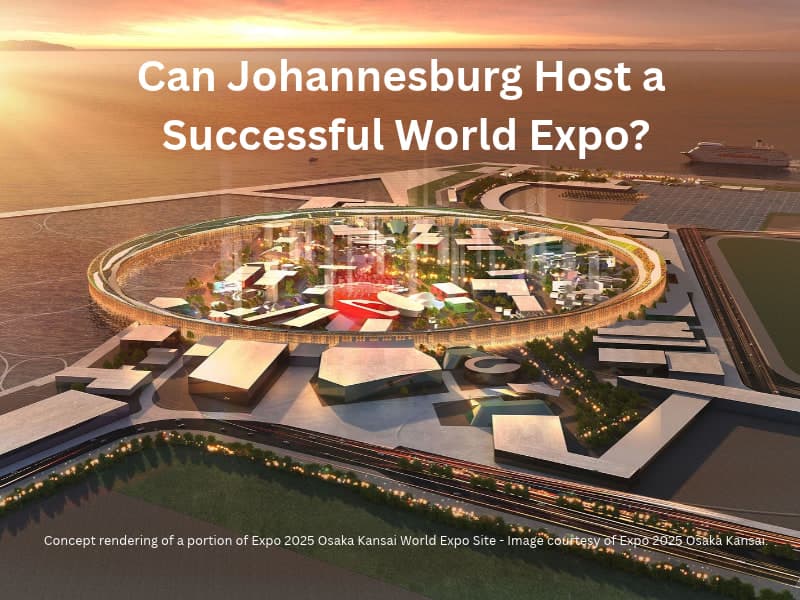
In 2025 Japan's Osaka hosted the event which attracted 25.58 million general visitors.
A country must submit a candidature between six and nine years before the proposed opening date. For 2035 the formal window is therefore opening now.
The process of selection includes Enquiry Missions that assess the proposed site, theme, financial guarantees, expected visitor numbers, political and social climate, and levels of government and public support. Host cities must demonstrate the capacity to build or upgrade infrastructure, manage logistics, and guarantee security and basic services.
Past hosts have spent heavily: Osaka’s venue construction alone reached the equivalent of several billion dollars, with broader infrastructure packages running into tens of billions.
Dubai’s preparations for Expo 2020 involved comparable multi-billion-dollar outlays on transport, hotels and utilities. Johannesburg would need to mobilise similar resources while already unable to maintain existing networks.
The Infrastructure Backlog in Numbers
Johannesburg city’s own figures show the scale of the gap. The mayor and the Integrated Development Plan put the combined infrastructure renewal and maintenance backlog at more than R220 billion. City Power’s share is R44.25 billion.
Johannesburg Water’s network of roughly 12,000 kilometres of pipes has seen only minimal replacement in recent reporting cycles—figures as low as 17 kilometres in one period. Non-revenue water stands at 44–49%. Physical losses alone run to hundreds of millions of litres a day, representing billions of rand in uncollected revenue annually.
Electricity losses remain in the 25–30% range. Customers have experienced average outages measured in tens of hours over multi-month periods, with some areas going without power for weeks due to grid failures or cable theft. Capital expenditure on infrastructure has repeatedly fallen well short of budgeted levels.
Real infrastructure investment in Johannesburg, has roughly halved over the past decade once inflation is taken into account.
The Fiscal Doom Loop
These shortfalls sit inside a fiscal cycle that the Centre for Development and Enterprise has described as a doom loop. Gross unpaid bills owed to the city rose from about R15 billion in 2014/15 to nearly R72 billion in 2024/25. By the later year, roughly one rand in every six billed was not being paid. The city has responded by raising tariffs on those who still pay, while postponing maintenance.
Employee-related costs have grown faster than cash collections. Trade payables to suppliers, including Eskom and Rand Water, have climbed above R28 billion. Development finance institutions have declined further loans citing governance concerns.
Adding to the friction, revenue from electricity and water sales has not been fully ring-fenced for the utilities, so funds intended for network repair are used or wasted elsewhere.
The result is that paying residents and businesses face higher charges for deteriorating services, while high-energy manufacturing becomes uneconomic once private power alternatives are factored in.
Governance Failures and Compounding Risks
Poor governance compounds the problem. The city has seen roughly ten mayoral changes in a decade under unstable coalitions. Procurement weaknesses, political appointments and weak contract management have been documented repeatedly.
A recent Global Initiative report on the crime-council ecosystem notes institutional capture, water-tanker contracts that create rent-seeking opportunities, and earlier forensic investigations covering transactions worth tens of billions of rand that were later set aside.
Illegal mining has contributed to road collapses and infrastructure pains, including sections of Wemmer Pan Road and other arteries; while historical mining and dolomitic geology are also factors, with ongoing underground activity continuing to undermine infrastructure.
Waste collection failures, sewage spills into streets, unreliable taxi enforcement and construction-related extortion are widely reported. These conditions raise insurance costs and deter the sustained private investment an Expo site and its surrounding transport links would require.
Why a World Expo Enquiry Mission Would Struggle to Clear a Johannesburg Bid
An Enquiry Mission would examine exactly these issues: whether the city and national government can deliver reliable bulk services, control security risks, collect revenue, and maintain political support for multi-year capital commitments. Current performance on those tests is weak. A successful bid would also require large new borrowing or grants at a moment when the municipality is already delaying payments to suppliers and facing collection shortfalls. Diverting scarce capital and management attention toward an Expo site while core networks continue to fail would deepen the doom loop rather than break it.
The Clear Answer to TEHA
The transparent answer to Mininni’s question is therefore a clear no, certainly not on present evidence.
The ranking correctly identifies Johannesburg’s comparative strengths in finance and business activity among emerging cities. It does not override the documented R220 billion backlog, the non-revenue losses of nearly half the water and a quarter or more of the electricity, the R72 billion unpaid-bills mountain, or the governance instability.
Hosting a single large event has never been the binding constraint; the binding constraint is the city’s inability to deliver basic, reliable services to its own residents and firms. The priority remains restoring collection discipline, fully ring-fencing utility revenues, accelerating pipe and cable replacement, appointing competent operators, and reducing leakage and theft.
Only after measurable progress on those fronts would an Expo candidature become a realistic rather than rhetorical proposition. Until then, the gap between the index ranking and the city’s operational reality is too wide for a 2035 bid to be credible.