South Africa’s Factories Inch Toward Recovery While Peers Pull Ahead
South Africa’s manufacturing sector edged closer to stabilisation in October 2026 but remained in contraction according to ABSA's latest PMI reading.
Manufacturing Still Stalling in South Africa
The Absa manufacturing PMI, released today, has lifted to a reading of 49.6 in October 2026, marking a second monthly gain after a year of mostly weak readings.
The index reading however remains below the expansion threshold, leaving South African manufacturers, and the small and medium businesses that supply them, behind stronger private-sector performance seen in Nigeria, Kenya and Ghana.
October Brings Gain, but Conditions Remain Soft
South Africa’s manufacturing sector edged closer to stabilisation in October 2026 but remained in contraction.
South Africa’s manufacturing sector edged closer to stabilisation in October 2026 but remained in contraction. The seasonally adjusted Absa Purchasing Managers’ Index rose 0.9 points to 49.6 from a revised 48.7 in September. This was the second consecutive monthly gain and the highest reading since May. All five components that make up the headline index improved during the month. Even so, the index stayed just below the neutral 50-point mark that separates expansion from contraction. Manufacturing conditions have therefore yet to return to growth territory.
Business activity rose to 48.6, recovering some ground from the sharp drop recorded in August. New sales orders increased for a second month to 46.8. Both readings remain below 50, showing that production and demand are still soft. Employment edged up from 42.8 to 44.2 but stayed well below the neutral line. Manufacturers continue to hold back on hiring while they wait for clearer signs that the recent improvement in orders will last. Inventories moved above 50 to 50.4, suggesting some firms are rebuilding stocks after earlier weakness. Supplier deliveries rose to 58.1. Because this component is inverted in the headline calculation, a higher reading indicates longer delivery times. Logistics delays, higher freight costs and port bottlenecks continued to affect the sector.
Purchasing prices climbed sharply to 73.7. Respondents pointed to higher transport, fuel and other input costs. The index that tracks expected business conditions in six months’ time fell from 55.3 to 51.7. Purchasing managers remain cautiously positive about the outlook but less so than a month earlier.
Contraction Continues Despite Some Improvement
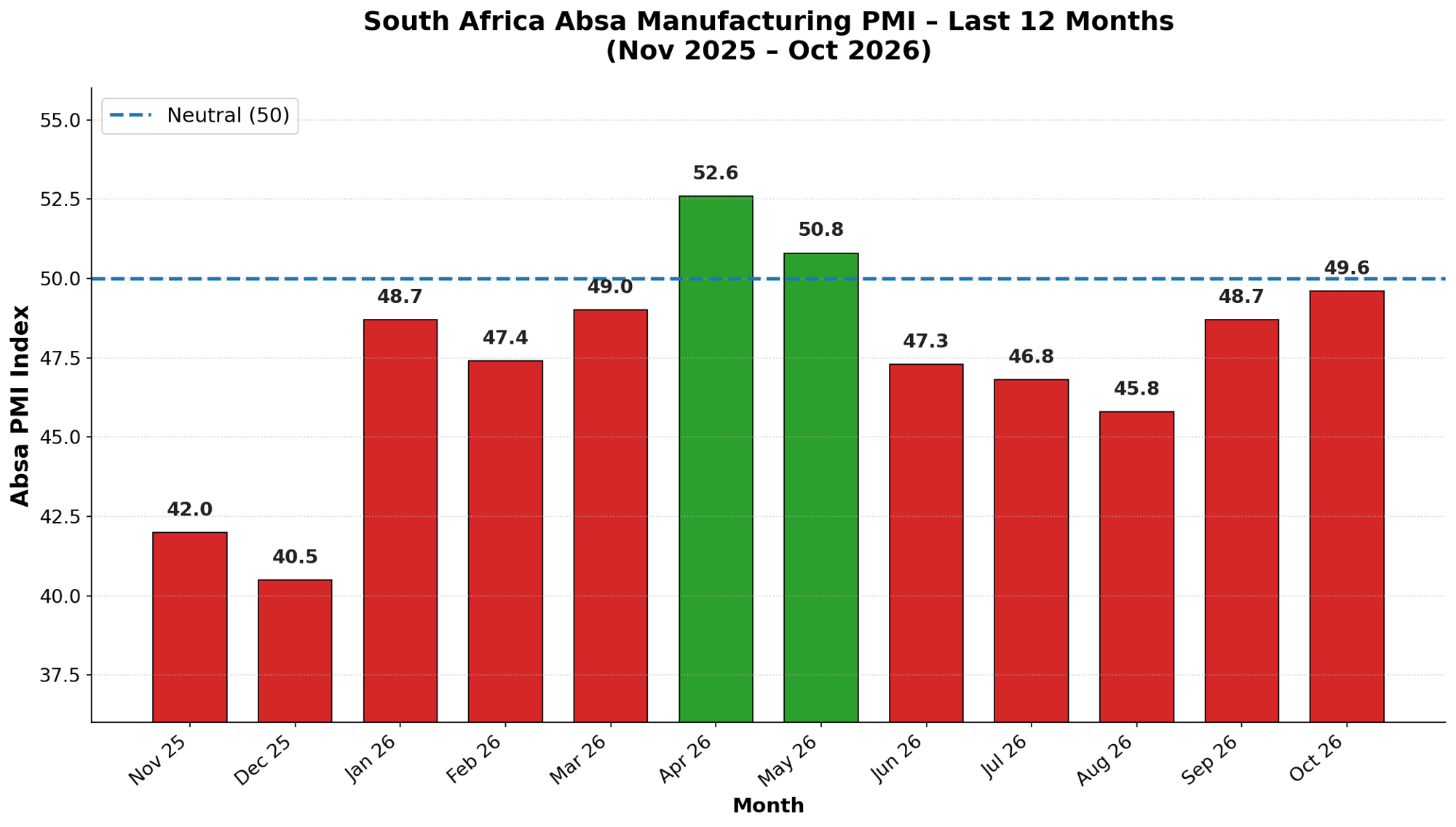
The modest October gain follows a year of predominantly weak readings. From late 2025 through much of 2026 the Absa PMI spent most months below 50. It fell to 42.0 in November 2025 and 40.5 in December 2025, the lowest levels of that year. It recovered only briefly in April 2026 (52.6) and May 2026 (50.8) before slipping back into contraction for the remainder of the winter months.
August 2026 marked the lowest point of the year at 45.8. The original September 2026 release had shown a return above 50 to 50.7, driven by a sharp rebound in new orders. The October release revised that September figure down to 48.7 after the annual update to seasonal adjustment factors. On the revised series the index therefore never crossed into expansion in September. The pattern over the preceding twelve months is one of persistent softness, with only short-lived moves above the neutral mark that were not sustained.
African Peers Show Clearer Expansion
This picture stands in contrast to conditions in several of South Africa’s larger peer economies. Nigeria’s Stanbic IBTC Bank private-sector PMI moderated to 55.7 in October from 56.4 in September. The reading remained firmly in expansion territory for a ninth consecutive month. Companies reported another rapid rise in new orders, supported by stronger customer demand and the launch of new products. Output continued to expand across all monitored sectors. Higher fuel and transport costs pushed purchase-price and selling-price inflation higher, but the overall improvement in business conditions stayed marked.
Kenya’s Stanbic Bank private-sector PMI lifted to 51.3 in September from 49.7 in August. The index returned above 50 and matched the joint-highest reading since January. New orders increased for a fourth consecutive month on the back of stronger market demand, referrals and marketing activity. Actual output still fell, although at the softest pace in seven months, as elevated costs and material shortages limited production. Employment rose for a fourth month. The improvement was demand-led rather than a broad-based recovery in activity.
Ghana’s S&P Global private-sector PMI saw a lift to 51.3 in September from 50.8 in August. This was the second consecutive month above 50 and the strongest reading since March. Output and new orders both increased for a second month. Firms linked the rise in orders to improving economic conditions, marketing efforts and client referrals. Employment rose solidly and business confidence reached a seven-month high. Inflationary pressures remained relatively muted compared with earlier in the year.
However, Egypt’s S&P Global non-oil private-sector PMI fell to 47.2 in September from 49.6 in August. The reading signalled a solid and accelerated downturn. Both output and new orders declined at faster rates. Firms cited weaker market conditions, geopolitical disruptions and elevated inflationary pressures from oil, metals, electricity and transport costs. Employment rose for a second consecutive month, the first back-to-back increase in more than a year, as companies expanded capacity to manage backlogs. Selling prices continued to rise strongly.
The relative performance is clear. Nigeria’s private sector remains the strongest among the group, with sustained expansion driven by refining, services and domestic demand. Kenya and Ghana have both moved back into modest expansion, supported by improving new orders even where output gains remain limited. Egypt continues to contract under the weight of cost pressures and weaker demand.
South Africa’s manufacturing PMI at 49.6 sits between these groups: it has improved for two months and is closer to stabilisation than earlier in the year, yet it has not matched the clearer expansion seen in Nigeria, Kenya or Ghana.
What the Reading means for Small and Medium Businesses
The October reading points to continued caution and headwinds for small and medium businesses that supply, serve or compete with South African manufacturers. Demand remains soft, with new sales orders at 46.8 and business activity at 48.6. SMEs that rely on manufacturing clients should expect slower payment cycles and fewer large orders in the near term. It is sensible in this environment to keep cash buffers intact and avoid expanding capacity until orders show clearer signs of lasting improvement.
Employment is still weak at 44.2%, with manufacturers not yet hiring in volume. SMEs that supply labour or temporary staff are likely to see limited new demand. Cost pressures are rising again, with the purchasing price index at 73.7 on higher transport, fuel and other inputs. Logistics delays continue to lengthen delivery times. SMEs face the same pressures and will need to review pricing more frequently and secure alternative suppliers where possible.
Inventories Lifted
Inventories edged above 50, which can create short-term opportunities for SME suppliers of materials and components, but only if they can deliver reliably and manage their own working capital. The six-month outlook index fell to 51.7, so any recent improvement in enquiries should be treated as tentative. Compared with peers, the contrast is sharp. SMEs that export to or partner with firms in Nigeria, Kenya or Ghana may find stronger demand there than at home.
Alignment with the Pan African Business Sentiment Index
These readings align with the Pan African Business Sentiment Index (PABSI) assessment for the third quarter and September 2026. PABSI, the composite developed by Business Tech Africa, closed September at –0.40 on its –10 to +10 scale, the highest reading since October 2025 and a clear improvement from the second-quarter average of –2.05. The index recorded the end of a nine-month slide. East Africa remained the strongest region, supported by steadier activity in Kenya and Ethiopia. West Africa held gains from Nigeria’s refining and services momentum. North Africa stayed weaker, with Egypt’s private-sector PMI still below 50. Southern Africa improved, with the original (pre-revision) Absa manufacturing PMI of 50.7 cited as a positive signal for the region after three months of contraction.
NOTE: A supplementary note is required on the September Absa figure. The October release revised the September headline PMI from 50.7 to 48.7 following the annual seasonal adjustment update. On the revised series South African manufacturing did not cross into expansion in September. The directional improvement highlighted by PABSI still holds—the index has recovered from the August low and recorded two consecutive monthly gains—but the move above 50 was an artefact of the earlier seasonal factors. The broader PABSI narrative of an uneven continental recovery, with East and West Africa ahead of Southern and North Africa, remains consistent with the latest PMI data.
Conclusion: Stabilisation is Here But not yet Recovery
South African manufacturers enter the final quarter of 2026 with conditions that have stopped deteriorating but have not yet turned to sustained growth. New orders and activity have recovered from their August lows, yet both remain below the neutral mark. Employment stays weak. Cost pressures have re-accelerated and logistics constraints continue.
For the small and medium businesses linked to the sector, the practical message is clear: protect cash, control costs, stay flexible on staffing and inventory, and look carefully at export or regional opportunities where private-sector momentum is stronger.
Peer economies show that private-sector expansion is possible under current global conditions. For South Africa the test is whether the modest gains of the past two months can be extended into a more durable recovery in orders, output and, ultimately, hiring. Until that happens, the manufacturing sector, and the SMEs that depend on it, will continue to lag the clearer momentum already visible among its African peers.