Pan African Business Sentiment Index - Q3 2026 Report Release
Pan African Business Sentiment Index has been developed by Business Tech Africa to provide an easy to use business overview of the African continent.
Pan African Business Sentiment Index
Third Quarter Sees Positive Uptick in Sentiment
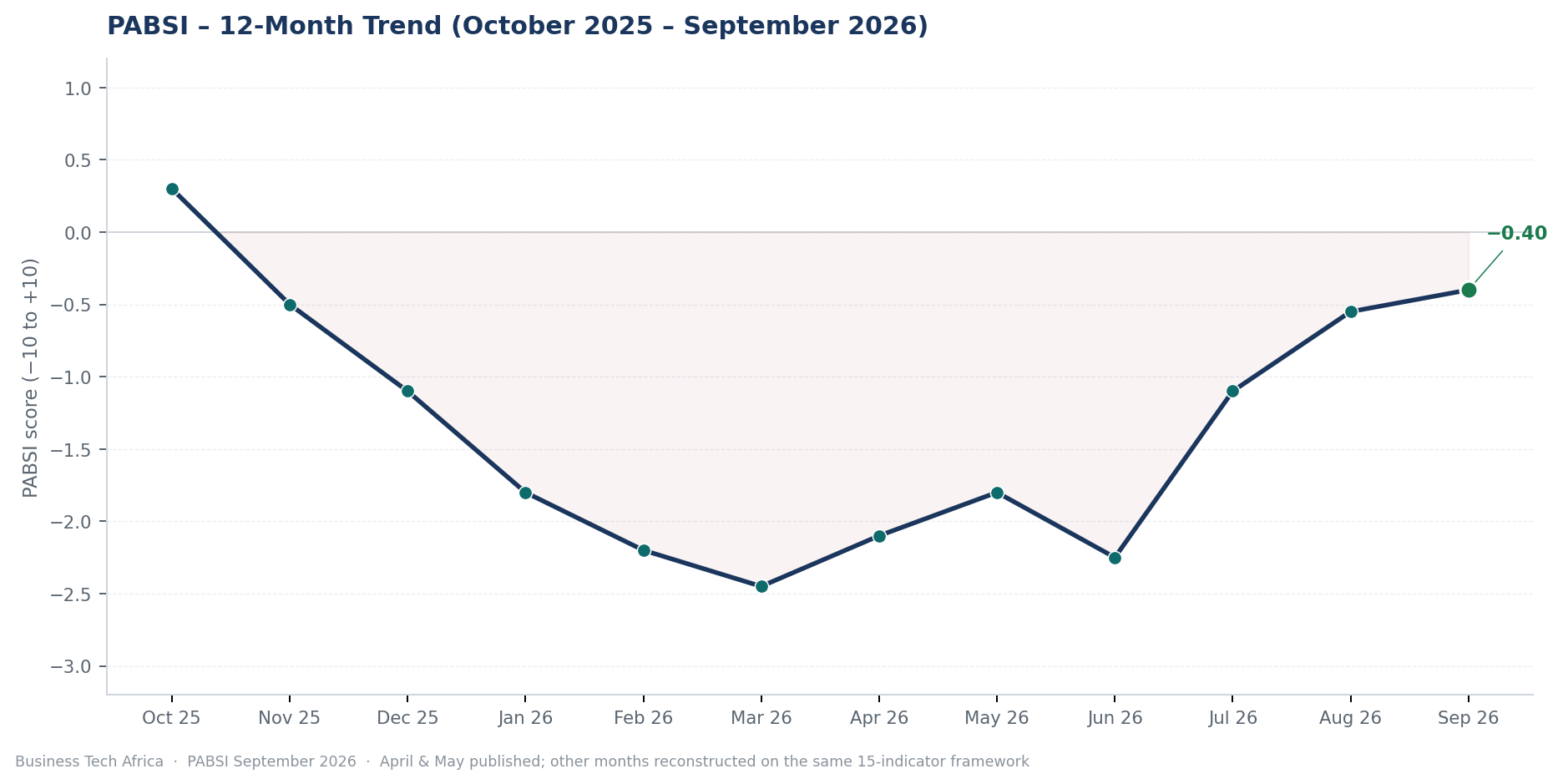
The Pan African Business Sentiment Index moved from a quarterly average of −2.05 (on a scale of -10 to +10) in the second quarter of 2026, to a reading of −0.67 in the third quarter (Q3), or a move of 1.38 points toward the positive end of the index range.
The September monthly close of −0.40 confirmed that the nine-month slide which began in mid-2025 had ended.
East Africa Leading The Recovery
The lift was broad but uneven. East Africa remained the strongest region, supported by steadier services and agricultural activity in Kenya and Ethiopia. Southern Africa recorded the largest regional improvement. South Africa’s Absa manufacturing PMI rose to 50.7 in September, the first reading above the 50 mark since May, driven by a sharp rebound in new orders. West Africa held the gains made in July and August as
Nigeria’s refining and services activity stayed above the expansion threshold. North Africa remained the weakest region. Egypt’s private-sector PMI stayed below 50 for most of the quarter, and the operating environment in several North African markets continued to be constrained by high import costs and limited private credit growth.
Growth in Key Sectors
Sector contributions shifted during the quarter. Real-activity indicators improved in services and light manufacturing across East and West Africa. South Africa’s manufacturing recovery added a positive reading after three months of contraction, although the business-activity sub-index remained just below 50 and employment continued to weaken.
Mining was a clear drag. Statistics South Africa reported that mining production fell 12.7 percent year-on-year in August, the steepest decline since October 2022, with platinum-group metals, coal and iron ore the main contributors.
Higher fuel prices raised input costs across transport, agriculture and manufacturing, and logistics delays at major ports continued to inflate supplier-delivery readings.
Funding and trade indicators improved modestly. Nigeria’s Dangote Petroleum Refinery reported a net profit of $4.73 billion for the first nine months of the year and extended its initial public offering on strong demand, providing a positive signal for regional energy supply and investor appetite.
Improvements Despite Headwinds
The index rose despite elevated oil and fuel prices because several offsetting factors strengthened at the same time. Domestic demand in a number of larger economies recovered faster than the pass-through from higher energy costs.
New-order indices in South Africa, Nigeria and Kenya moved back above or closer to the expansion threshold. Inflation remained high but did not accelerate further in most markets after the initial spike, giving central banks room to keep policy rates unchanged. Export receipts from gold, copper and agricultural commodities stayed supportive in several countries, and the gradual improvement in services and refining activity offset part of the mining weakness.
The International Monetary Fund’s October World Economic Outlook projected sub-Saharan Africa growth at 4.5 percent for 2026, slightly above its July forecast, reflecting the same underlying stabilisation.
Fresh Momentum in African Economy
The third-quarter reading therefore marks a clear change in direction rather than a full recovery. Conditions remain in negative territory on the −10 to +10 scale, and the operating environment continues to carry the weight of higher fuel costs, logistics bottlenecks and uneven employment trends.
The data does show, however, that the worst of the multi-month decline has passed and that momentum is rebuilding in services, selective manufacturing and regional refining, even while mining and energy-cost pressures remain facing headwinds.