Côte d’Ivoire gets $14.3m for SME finance
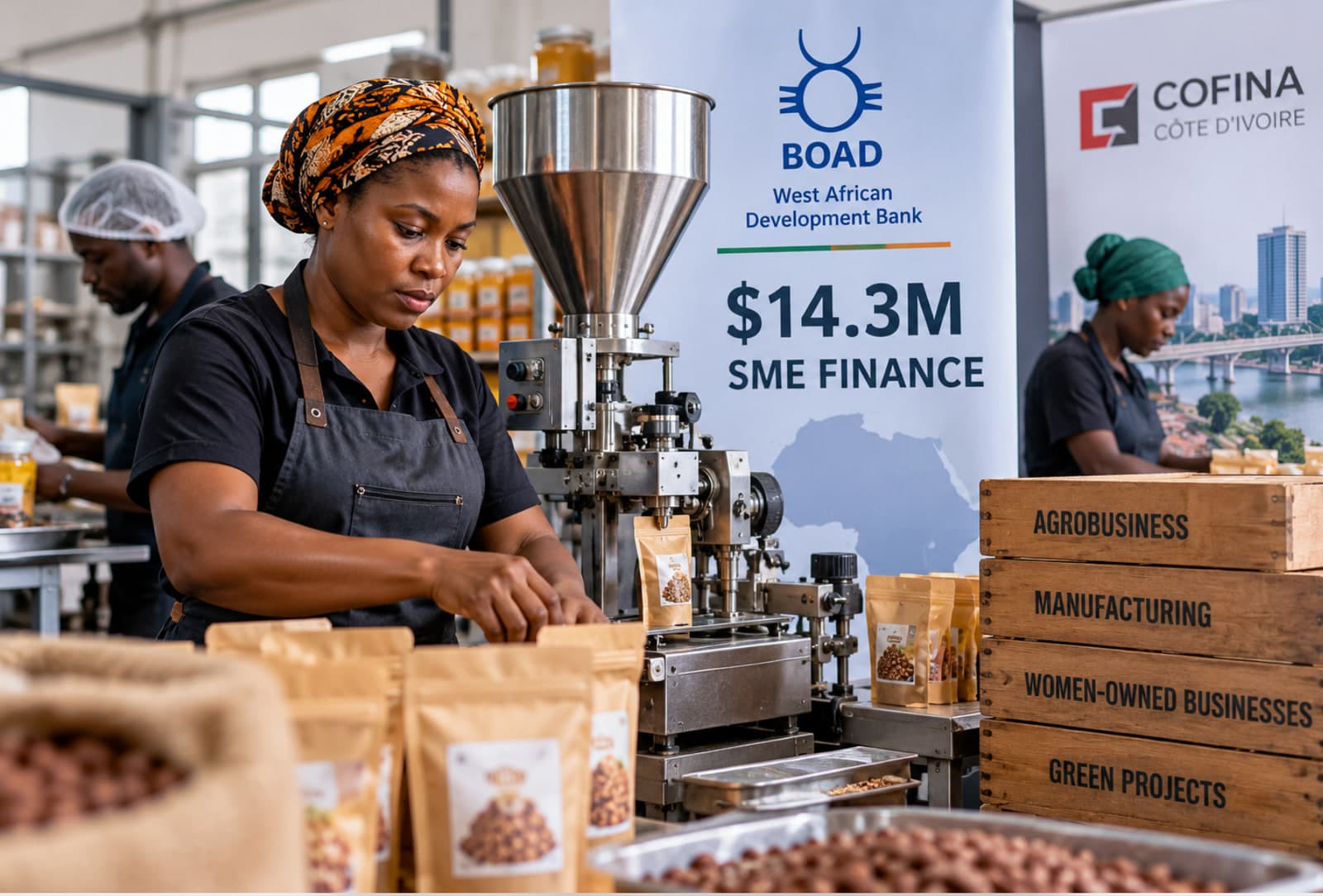
A 10 billion CFA franc ($14.3 million) financing facility is being made available to small businesses in Côte d’Ivoire through COFINA Côte d’Ivoire.
Côte d’Ivoire
A 10 billion CFA franc ($14.3 million) financing facility is being made available to small businesses in Côte d’Ivoire through COFINA Côte d’Ivoire. The money comes from the West African Development Bank (BOAD) and will be used mainly to provide medium-term financing to SMEs and small industrial businesses.
AI-generated summary. It can miss nuance — read the full story above for the complete picture.
A 10 billion CFA franc ($14.3 million) financing facility is being made available to small businesses in Côte d’Ivoire through COFINA Côte d’Ivoire. The money comes from the West African Development Bank (BOAD) and will be used mainly to provide medium term financing to SMEs and small industrial businesses.
Women-led businesses and green projects are also included. For a small company, this is less about a big funding announcement and more about whether it can finally afford the thing it has been putting off. That could be a machine, a delivery vehicle, more stock or equipment for a new contract.
A machine can be a big expense
“A business can have customers and still struggle to get the money it needs to grow.”
A small manufacturer may have enough orders to increase production but not enough cash to buy another machine. The same problem comes up in other businesses. A food processor may need new packaging equipment. A farmer may need irrigation. A cold-storage operator may need another refrigeration unit. A transport business may need another truck.
These purchases can take months or years to pay for themselves. That makes a short-term loan difficult to use. The business has to start repaying the money before the investment has had much time to produce extra income. Medium term finance gives it more breathing room.
Banks don't work for every business
This is where companies such as COFINA come in. A growing business may have sales, customers and employees but still struggle to get a traditional bank loan. The problem might be collateral. It might be the company's financial history. Or the business may simply be asking for an amount that does not fit neatly into a bank's lending model. COFINA reported more than 90,000 customers at the end of 2025, with 76 billion CFA francs in outstanding loans and 139 billion CFA francs in assets. The BOAD facility gives it additional money to lend.
Bigger orders can create a cash problem
Working capital is another issue. Imagine a small company that wins a contract to supply a supermarket or larger manufacturer. The order may be good news, but the company still has to buy materials, pay workers and get the goods delivered before it receives payment. Without enough cash, it may not be able to take the order. This is one reason finance can matter even when a business is already making sales.
Women-owned businesses are part of the target
Some of the new financing is earmarked for women-led businesses. That does not change the basic problem facing the business owner. If a company wants to expand, it needs money to do it. That could mean buying stock, taking on staff, renting additional premises or purchasing equipment. The useful question will be how much of the financing actually reaches these businesses and what they use it for.
Green finance can be quite ordinary
The green projects covered by the facility do not have to be huge. A small factory could install solar panels. A food business could replace an old refrigeration system. A farm could invest in more efficient irrigation. A manufacturer could replace equipment that uses too much electricity. For the business owner, the calculation is usually simple: how much will this cost, and how much will it save or earn? The environmental benefit comes alongside that calculation.
$14.3m sounds big. It isn't spread very far.
Côte d’Ivoire has thousands of small businesses, so the facility will not solve the country's SME financing problems. The money has to be divided among borrowers, and those borrowers still have to meet COFINA's lending requirements. What matters will be what happens after the money leaves the financing agreement.
If a small manufacturer uses it to buy a machine and increase production, that is one result. If a farm uses it to install irrigation and produce more crops, that is another. If a transport company uses it to add vehicles and take on more deliveries, the effect is visible in the business itself. That is where this $14.3 million will have to prove its value.