Audi Is Testing Humanoid Robots. What Could This Mean for South African Factories?
Picking parts off a shelf and putting them in the right place is ordinary work in a car factory. But when a plant handles thousands of components every day, getting that job wrong can hold up production.
Audi
Picking parts off a shelf and putting them in the right place is ordinary work in a car factory. But when a plant handles thousands of components every day, getting that job wrong can hold up production.
AI-generated summary. It can miss nuance — read the full story above for the complete picture.
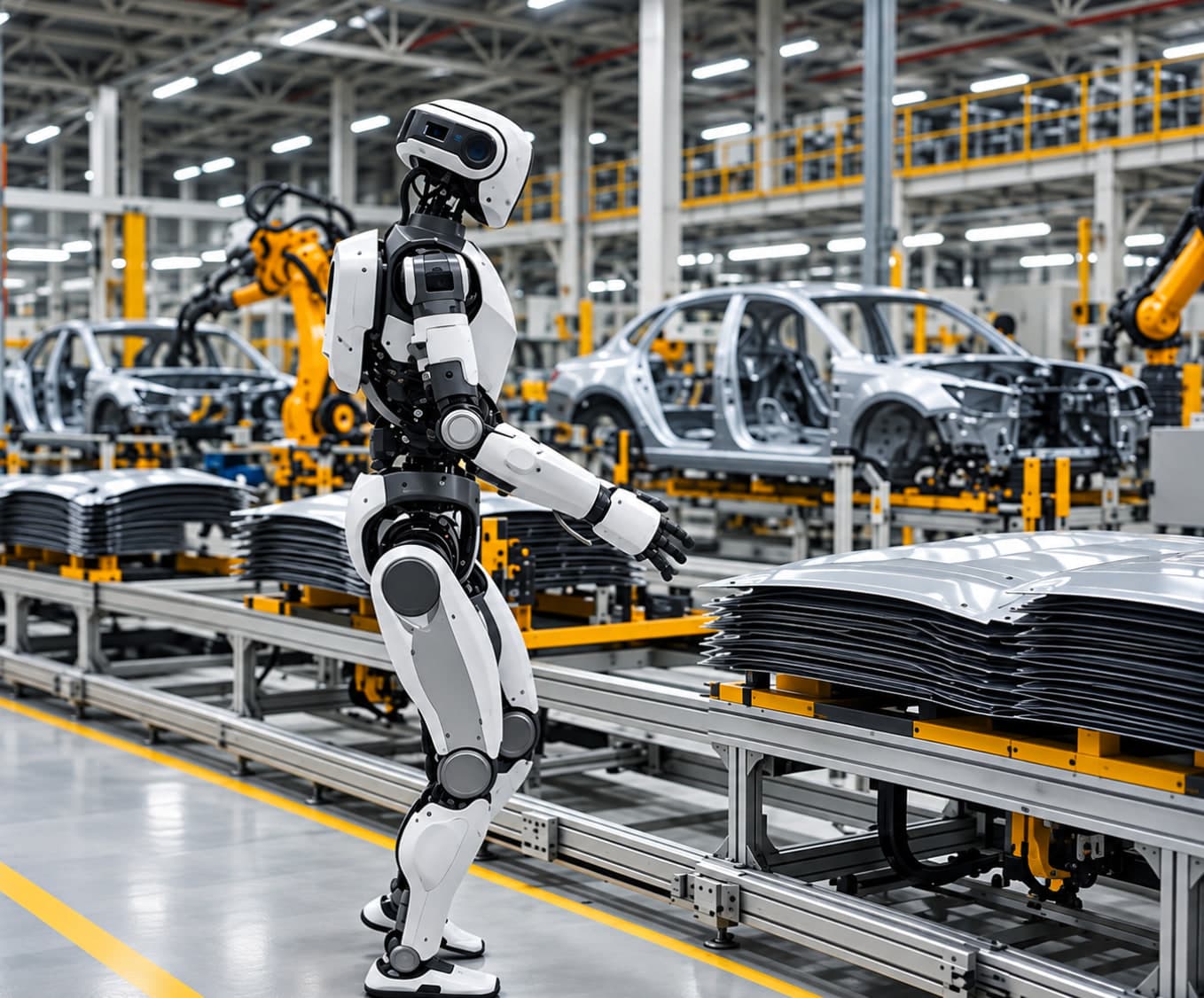
Picking parts off a shelf and putting them in the right place is ordinary work in a car factory. But when a plant handles thousands of components every day, getting that job wrong can hold up production. Audi is testing whether humanoid robots can take on some of this work at its factory in Ingolstadt, Germany. The trial focuses on picking components from containers and arranging them for vehicle assembly.
The project brings Audi together with robotics company Agile Robots, software firm Dassault Systèmes and technology company NVIDIA. Audi announced the trial on 21 October 2026. The company says its material-supply operations involve around one million picks a day. That gives an idea of the scale of the work, but it does not mean the robots are already handling those tasks across the factory. Audi is still testing the technology.
Can the robots do the job without slowing production?
“For a factory owner, appearance matters less than reliability, speed, maintenance costs and the effect on production.”
Car manufacturers have used industrial robots for years. Welding, painting and moving heavy components are established applications. Humanoid robots are being tested for jobs that require more flexible handling of individual items. In Audi's trial, the machine must identify a component, pick it up and place it where it is needed. The challenge is doing this accurately and repeatedly, even when parts differ in shape and size.
A mistake on a production line can cost time. If a robot drops a component, selects the wrong part or needs frequent intervention, the factory may be better off using its existing process. Audi and its partners are testing the technology in a controlled environment and using a virtual factory model to assess how it might fit into the operation. The company has not announced a wider rollout or disclosed what deploying the robots would cost. That leaves an important question unanswered: can the robots do the work reliably enough to justify the investment?
The opportunity may be in keeping the machines running
South African businesses do not need to build humanoid robots to take part in factory automation. Manufacturers already need electrical technicians, machine maintenance companies, software integrators and suppliers of industrial components. When equipment fails, someone has to find the fault and get production moving again.
For engineering SMEs, developing these services may be a more realistic opportunity than investing in humanoid robotics themselves. A company that maintains factory machinery, for example, could train staff in industrial controls, sensors or robotic systems if its customers begin asking for those skills. But Audi's trial is not evidence that South African factories are about to buy humanoid robots. Local opportunities will depend on what manufacturers actually invest in and whether they use outside suppliers to install and maintain the equipment. For now, businesses should look at the automation already being used by their customers and ask where they can provide a useful service.
What does this mean for factory workers?
If robots can handle repetitive parts-picking tasks, some jobs could change or require fewer people. That is a reasonable concern for workers whose roles involve moving and sorting components. Audi has not announced job cuts linked to this project. The company says the trial is intended to reduce manual workloads and improve efficiency. What happens to staffing will depend on whether the technology is adopted more widely and how manufacturers reorganise the work.
There will also be a need for people who can supervise equipment, carry out maintenance and deal with faults. That does not guarantee that new jobs will replace every role affected by automation, but it does make technical training an important part of the discussion. South African manufacturers face their own decisions about productivity, labour costs and the skills available locally. Audi's experiment offers a glimpse of what factories are investigating, rather than a blueprint for what local plants should buy next.
Wait for the results
Humanoid robots attract attention because they look like people and may be able to work in spaces designed for people. For a factory owner, however, appearance matters less than reliability, speed, maintenance costs and the effect on production. Audi has yet to show whether this trial will lead to wider use of the technology. For South African engineering businesses, the sensible move is to understand the equipment manufacturers are using today, speak to customers about their maintenance and skills needs, and invest in training where there is real demand. The robots may eventually take on more factory work. First, they have to prove they can do the job without creating a new set of problems.