
This is the budget set aside for Ramaphosa's salary in 2023 and beyond
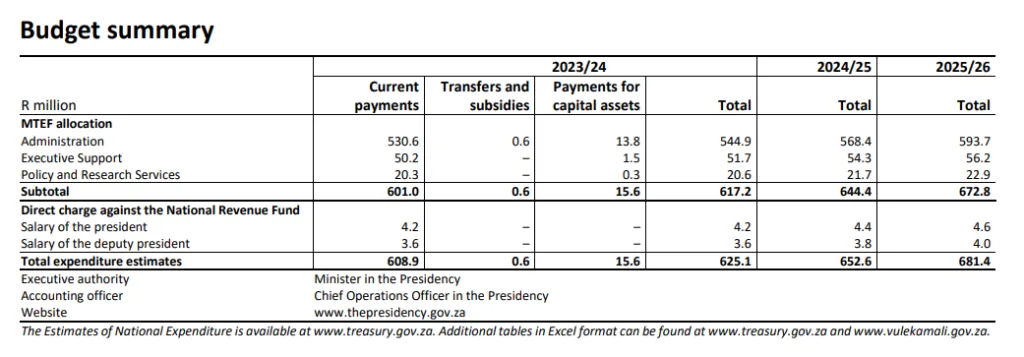
The National Treasury is planning a large compensation package for President Cyril Ramaphosa and the country's Deputy President. The presidential budget for 2023/24 to 2025/26 anticipates that the president's pay would rise from R4.2 million (unchanged from 2022/23) to R4.6 million throughout the period. Meanwhile, the deputy president's salary is set to rise by R100,000
This is the budget set aside for Ramaphosa's salary in 2023 and beyond
The National Treasury is planning a large compensation package for President Cyril Ramaphosa and the country’s Deputy President.
The presidential budget for 2023/24 to 2025/26 anticipates that the president’s pay would rise from R4.2 million (unchanged from 2022/23) to R4.6 million throughout the period.
Meanwhile, the deputy president’s salary is set to rise by R100,000 to R3.6 million in 2023, rising to R4.0 million by the conclusion of the year.
It should be emphasised that the budget projections are not the president’s and vice president’s confirmed salaries, but rather the budget’s allowance for these payouts.
The Independent Commission for the Compensation of Public Office Bearers proposes government wages, which are subsequently authorised or changed by the president.
The panel also recommends the president’s pay, which must be approved by parliament.
For example, while the budget provided for an R4.2 million income for the president in 2022, wage freezes in 2020 and 2021 due to Covid-19 reduced his pay to R3 million in 2022.
Nonetheless, the deputy president’s salary increased to R2.9 million, above the R3.5 million budgeted for that year.
From 2018, Ramaphosa has also donated half of his salary to charity.
He vowed to contribute half of his income to the Nelson Mandela Foundation in 2018 to promote early childhood development programmes. The organisation verified to News24 that the president kept his pledge and has profited from the donations over the previous four years.
However, the presidency stated that the gift to the foundation will end in 2022 since other organisations would benefit.
The salary rises – or lack thereof – of top government officials will continue to be scrutinised, especially in light of the National Treasury’s declared goal to reduce the government payroll bill.
While finance minister Enoch Godongwana stated that he did not want to go ahead of discussions with the public sector during his statement on Wednesday, his department is nonetheless facing a furious response from unions for unilaterally imposing a 3% increase in the current fiscal year.
Raising the pay of rich ministers and government officials while lower-wage employees battle for even an inflation-linked raise would convey the incorrect message.
Godongwana stated during his address that the government’s gross debt stock is expected to rise from R4.73 trillion in 2022/23 to R5.84 trillion in 2025/26.
He went on to say that the public sector salary bill will top R701.2 billion, exceeding a figure he had predicted for 2025.
This is due in part to the additional R14.6 billion it spent to support salary rises following its unilateral execution of a 3% hike in October last year, which public workers remain dissatisfied with.
Unions are still fighting for a greater rise in light of South Africa’s cost of living problem, claiming that this increase is insufficient because it is less than inflation.
Godongwana, on the other hand, identified unsustainable public-service wage bill settlements as one of the significant dangers to South Africa’s budgetary outlook, adding that tougher measures to manage the public service’s notoriously bloated headcount are required to reign down expenditure.
South Africans are going through a difficult period
Despite efforts to address the wage bill and government wages, Treasury cannot avoid the reality of South Africa’s growing cost of living.
While headline inflation dropped in January and has continued to do so – predicted to average 5.3% in 2023 from 6.9% in 2022 – inflation for crucial commodities such as food and non-alcoholic beverages (NAB) has accelerated.
In January, the annual rate for food across all categories rose to 13.4%, the highest number since April 2009, when it was 13.6%.
Furthermore, the country’s economy is still being dragged down by the ongoing energy crisis, which adds even more financial constraints through direct and indirect expenditures.
South Africa suffered over 200 days of load shedding in 2022, and the country has already seen 53 days of power outages in 2023 as of February 23rd, with the majority of these occurring at higher levels.
The country is now experiencing stage 6 load shedding, and energy experts and analysts have predicted that stage 8 load shedding would occur by the middle of the year.
Already, load shedding has cost the country’s economy hundreds of billions of rands. Meanwhile, the South African Reserve Bank forecasts that the current stage 6 will cost the economy R899 million per day.