South Africa’s Commodity Tax Buffer Has Ended - Politics is Set to Hurt Growth Further
Our unique take on the current two-year period in which higher gold and platinum-group metal prices delivered large tax income that the rest of the economy could not produce in South Africa. Those prices are now falling. At the same time, the results of the 4 November 2026 local government elections have produced coalition arrangements in the country’s largest cities that deliberately exclude the only major party with a recent record of competent municipal administration. The combination removes the fiscal cushion that hid the cost of weak growth.
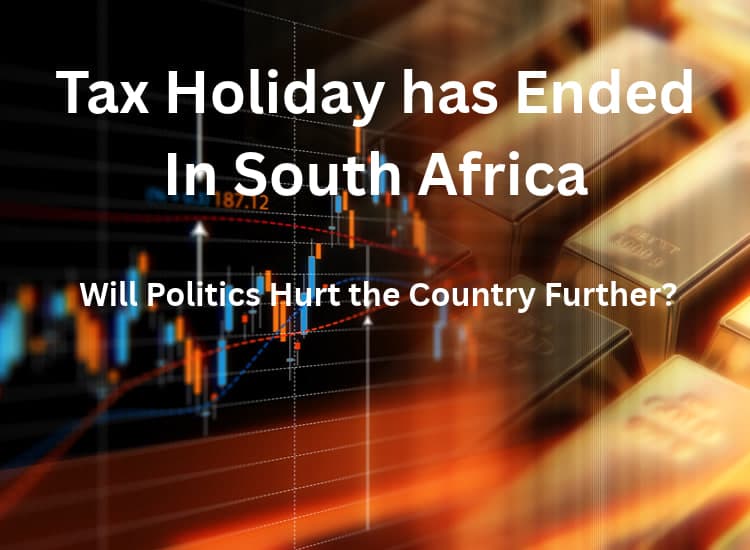
Tax Holiday has Ended In South Africa
South Africa has just closed a two-year period in which higher gold and platinum-group metal prices delivered large tax receipts that the rest of the economy could not produce. Those prices are now falling. At the same time, the results of the 4 November 2026 local government elections have produced coalition arrangements in the country’s largest cities that deliberately exclude the only major party with a recent record of competent municipal administration. The combination removes the fiscal cushion that hid the cost of weak growth, high unemployment and failing local government. Markets have already begun to price the risk. The question is whether the national government and the new municipal coalitions will correct course before the damage becomes harder to reverse.
The Tax Surplus Rested on Metal Prices, not a Stronger Economy
National Treasury recorded primary budget surpluses in both the 2023/24 and 2024/25 years. These were the first consecutive primary surpluses since 2009. Net tax collections reached R1.855 trillion in 2024/25. Personal income tax rose strongly, helped by wage growth in finance and community services and by early withdrawals under the two-pot retirement system. Corporate tax also increased. Mineral royalty collections, however, were driven by higher gold and platinum-group metal prices rather than by higher production volumes. The Minerals Council noted that the revenue lift came from prices, not from more tonnes mined. In the first months of the 2025/26 fiscal year mineral royalties rose sharply for the same reason. Exports of precious metals and stones accounted for a large share of the trade surplus recorded in the first nine months of 2026, while the value of most other exports weakened.
South Africa still has advantages that other African economies lack: a deep financial market, established mining and manufacturing capacity, and a relatively sophisticated services sector - Those advantages are not permanent.
That support has narrowed. Platinum prices that reached nearly $2,900 an ounce early in 2026 have fallen toward $1,300–$1,400. Palladium has dropped to multi-month lows near $900–$1,000 an ounce. Gold has retreated from its earlier peaks. A stronger US dollar, reflecting expectations of tighter Federal Reserve policy, has reinforced the decline and pushed the rand weaker. By 19–20 November 2026 the currency traded near R17.30–R17.45 to the dollar, its weakest level in more than a year. Ten-year government bond yields moved higher toward 8.8–9 percent. The fiscal buffer that higher metal prices provided is no longer available at the same scale.
Local Election Results Lock in Weak Municipal Governance
The 4 November local elections left 138 of 213 councils without a single-party majority, including seven of the eight metropolitan municipalities. The African National Congress received 30.76 percent of the national vote and the Democratic Alliance 24.64 percent. The Democratic Alliance finished first in Johannesburg, Tshwane and Ekurhuleni. Coalition talks have produced an emerging arrangement among the ANC, ActionSA, the Economic Freedom Fighters and the uMkhonto weSizwe Party that excludes the Democratic Alliance from executive control of those three Gauteng metros. ActionSA’s Herman Mashaba is expected to become mayor of Johannesburg.
The Auditor-General’s latest reports show why this matters. Only 39 municipalities, or 15 percent, received clean audits in the 2024-25 cycle. One hundred and sixteen municipalities adopted unfunded budgets. None of the eight metros achieved a clean audit. Infrastructure projects reviewed by the Auditor-General showed widespread problems, including payments for work not delivered and long delays. Municipalities continued to owe large sums to Eskom and had failed to remit roughly R2 billion in employee pension contributions by mid-2026. These failures pre-date the election. The new coalitions inherit the same balance sheets and the same weak financial controls. Choosing to exclude the party with the stronger recent municipal record reduces the probability that service delivery and financial management will improve in the cities that generate most of the country’s economic activity.
Markets and Rating Agencies are Already Reacting
Credit-rating agencies have recognised the national fiscal improvement. S&P Global Ratings upgraded South Africa to BB with a positive outlook in November 2025. Fitch Ratings upgraded the country to BB in June 2026. Moody’s maintains a Ba2 rating with a positive outlook. All three remain two notches below investment grade. They cite primary surpluses and progress on energy and logistics reforms. They also note that growth remains too low to reduce unemployment or debt ratios quickly. Treasury and the South African Reserve Bank both forecast real GDP growth of about 1.2 percent in 2026. The official unemployment rate stands near 33–34 percent.
Markets have treated the combination of fading commodity support and local political uncertainty as a negative signal. The rand has weakened and bond yields have risen even though the national primary-surplus path is still intact. Investors are not yet staging a full withdrawal, but they are demanding a higher risk premium. Further deterioration in municipal finances or any reversal of national fiscal discipline would widen that premium.
External Shocks Remove Another Source of Support
On 2 November 2026 the United States notified Congress and the South African government of its intention to remove South Africa from the African Growth and Opportunity Act with effect from 1 January 2027. The stated reasons include insufficient progress on corruption, barriers to US trade and investment, and concerns related to national security and foreign policy. AGOA itself continues until the end of 2028 for other countries. South African exporters will retain most-favoured-nation access, but they will lose the duty-free preference. Automotive and agricultural products that rely on the preference face higher tariffs. Government officials have said the loss is not a complete cutoff of the US market. The decision nevertheless removes one source of preferential access at the moment when commodity-price support for the fiscus is fading.
The Potential Fallout is Already Visible
The most immediate fallout is higher borrowing costs and a weaker currency. Higher bond yields raise the cost of refinancing existing debt and of funding new infrastructure. A weaker rand raises the cost of imported fuel and other inputs, feeding into inflation and reducing real household incomes. Municipalities that continue to adopt unfunded budgets and fail to maintain infrastructure will deliver less reliable electricity, water and sanitation. That reduces the productivity of businesses that depend on those services and discourages new private investment. The exclusion of the Democratic Alliance from the major metros makes an improvement in those services less likely in the near term.
If primary surpluses shrink because metal prices stay lower and if growth remains near 1%, the debt-to-GDP ratio will stop falling and may begin to rise again. Rating agencies that have recently upgraded or placed South Africa on positive outlook would then have grounds to reverse course. A further downgrade or a loss of the positive outlook would raise borrowing costs still more. Unemployment would remain near record levels because growth at 1.2 percent cannot absorb new entrants to the labour market. The combination of higher costs, unreliable municipal services and continued high unemployment would make it harder for South African firms to compete with peers in other African countries that are expanding faster.
Some Residual Value Remains
South Africa still has advantages that other African economies lack: a deep financial market, established mining and manufacturing capacity, and a relatively sophisticated services sector.
Those advantages are not permanent. They erode when infrastructure fails, when policy signals deter investment, and when the tax base depends on a narrow set of commodity prices that have already turned lower. The national government has shown it can deliver primary surpluses when metal prices are high. It has not yet shown it can maintain that discipline and raise growth when prices are lower. The new municipal coalitions have not yet shown they will reverse the pattern of unfunded budgets and weak financial controls documented by the Auditor-General.
The trajectory can still be changed. National fiscal consolidation can continue without the commodity windfall if expenditure growth stays restrained. Municipal coalitions can prioritise basic financial management and service delivery over political exclusion. Structural reforms in energy and logistics can be accelerated rather than slowed. None of those steps is guaranteed by the choices made in the past two weeks. If the current path continues, South Africa will not remain the leading economy on the African continent by default. Other countries are expanding their markets, improving their infrastructure and attracting capital that South Africa once took for granted. The next 12 to 18 months will show whether South Africa corrects its course or cedes that position through inaction.