Mining Leaders Outline Path to Growth at the Joburg Indaba
Speakers at the Joburg Indaba highlighted several areas South Africa needs focus on to be competitive and investor friendly in order to positively impact economic growth and job creation.
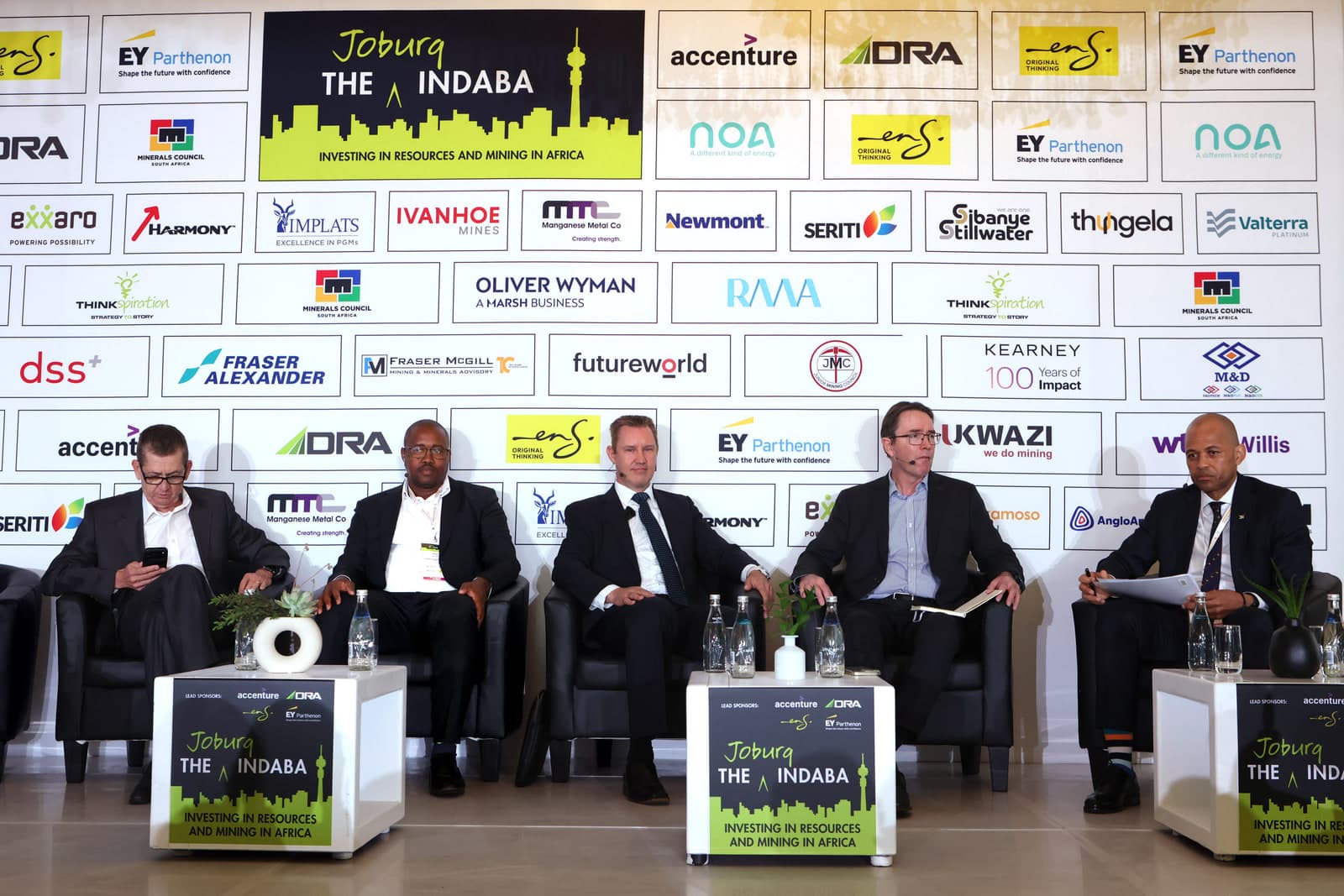
Joburg Indaba Panel Discussion - Day 2
Hosted by Resources 4 Africa, the Joburg Indaba is underway at the Inanda Club in Johannesburg.
Bernard Swanepoel, Chairman of Joburg Indaba, said “in the last few years talking about the South African mining industry has been like discussing someone you care about who is in ICU. I wonder if we are maybe moving from crisis management to start talking about opportunity management. Suddenly the world wants what we have. Mining is sexy.”
However, Swanepoel added that though South Africa has “a century of mining capability investors are hardly falling over themselves to be here. Our mineral endowment is not enough. We cannot say our problems have completely disappeared, though there has been improvement. But geology is not destiny. Other countries are reforming too. Other jurisdictions are building capacity. We have to earn it. I am excited about the opportunities,” Swanepoel said.
The pressure brought to bear on the mining sector from geopolitics was raised by several panellists, who noted that while challenging it created opportunities. Craig Miller, CEO of Valterra Platinum, said geopolitics has shown how important minerals are, it results in diversifying supply and that creates opportunities for mining companies to leverage.
Speakers at the Joburg Indaba highlighted several areas South Africa needs focus on to be competitive and investor friendly in order to positively impact economic growth and job creation.
Natascha Viljoen, President & CEO of Newmont, said, “we need to ask ourselves what is the work we have to do to lead the mining industry. South Africa is a cornerstone of the mining industry globally, considering the skills from the country.”
Viljoen, who was inducted into The Joburg Indaba Hall of Fame in recognition of her contribution to the mining industry, said resolving loadshedding has been a great achievement, but “the reality is it takes time to rebuild trust. The moment capital has left; the biggest challenge is to get the money back.”
Duncan Wanblad, CEO of Anglo American, said South Africa has a solid foundation for what should be one of the most competitive mining jurisdictions. To attract investment the country needs to “continue addressing administrative complexity that leads to delays and uncertainty. Not only permitting, but also the successful implementation of the cadastral system, which should improve transparency and unlock project development.”
Wanblad said the good progress in rail and logistics reform was hugely encouraging and needed to be continued. Likewise progress in ensuring the country’s energy security was positive, as well South Africa being removed from the grey list and the improvement in sovereign credit ratings.
Futhi Mtoba, Independent Chairperson of the Ore Expert Corridor Users Forum, said logistics reform remains one of the most important conversations facing South Africa's mining industry and broader economy to unlock growth, improve competitiveness and restore confidence in the country's freight logistics system.
Beyers Nel ,CEO of Harmony Gold Mining Company, said while the high gold prices will result in incremental growth and there is still a lot of gold, “it is deep and is costly to extract. I think as reforms gather momentum… the opportunities that appear a bit murky today could become clearer depending on what course of action we take as a country going forward.”
Michelle Phillips, Group Chief Executive of Transnet, said the state-owned enterprise’s focus remains on operational improvement in moving core commodities. “Can we do this without the private sector, no.”
Phillips added that “there is a misconception that Transnet is government and we can access this big pot of money. Transnet does not receive any funding from government. We have to go to the market to get funding.”
Richard Stewart, CEO of Sibanye-Stillwater, said in South Africa our biggest crisis is poverty and to create jobs requires investment. “We spend a lot of time thinking about how to cut up the pie, not how we can grow the pie. As a country, we need have to discussions around policy and regulations that are solutions driven not ideological.”
Paul Dunne, President, Minerals Council South Africa and CEO of Northam Platinum, said the inclusion of mining as one of three key economic sectors in the third phase of the Government-Business Partnership under the Presidency recognises the sector's scale, its capacity to attract investment and its ability to generate activity throughout the broader economy through powerful multiplier effects that create upstream jobs.
Ben Magara, CEO of Exxaro, said “disciplined execution is what we need. Getting our boots dirty and getting it done.”