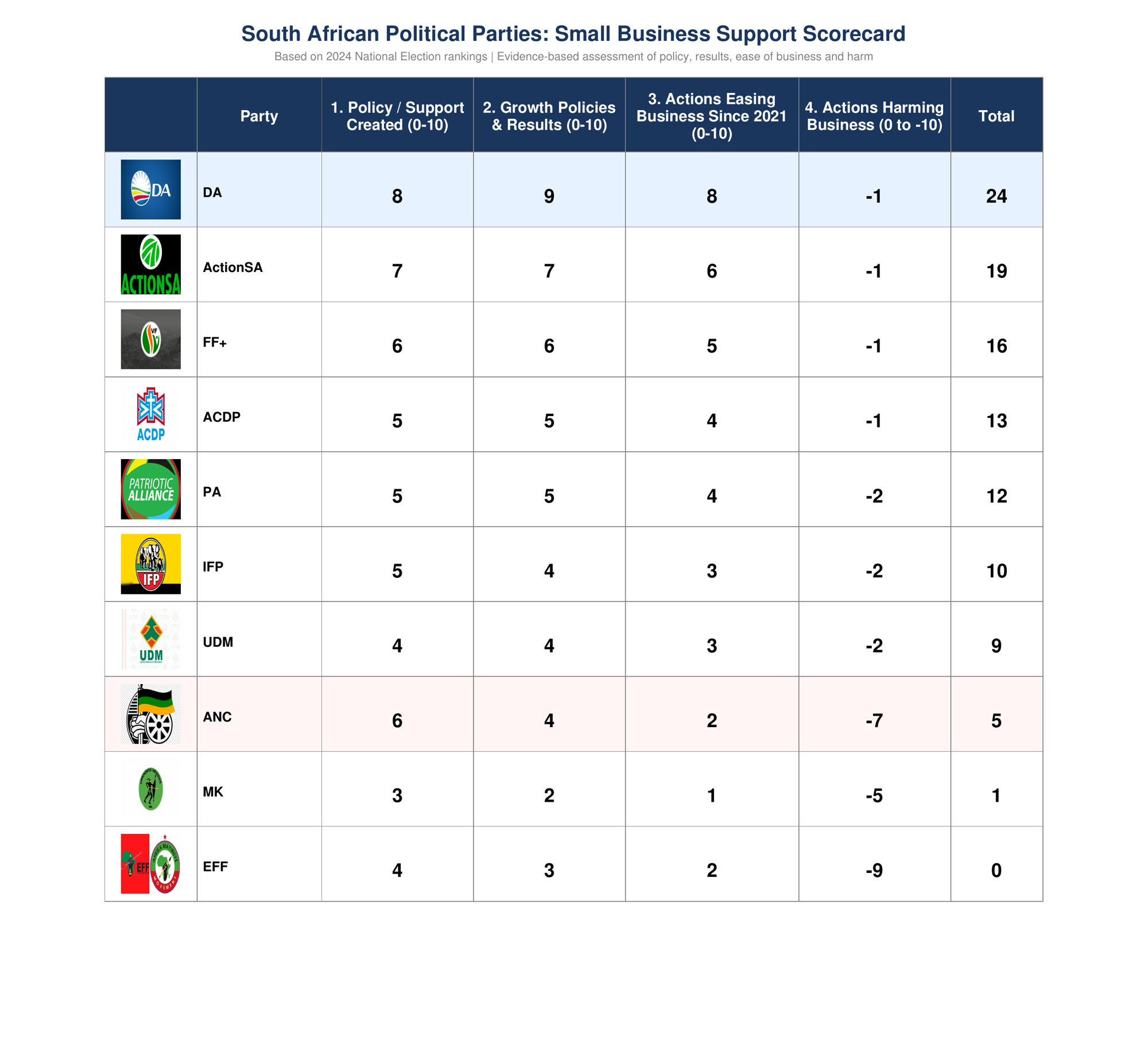
Scorecard for South Africa’s Top 10 Political Parties on Small-Business Performance.
There is much lip-service paid to supporting SME's but in reality there has been little done in the way of practical support for these critical economic engines in South Africa.
SME's and Local Elections
Scorecard for South Africa’s top 10 parties (by 2024 National Assembly vote share) on small-business performance.
Regularly overlooked by political parties, small and medium businesses are truly the heart of the economy, not due to their income and contribution to company tax income, but by their employment power.
While larger corporations ensure that there is a big contribution towards the government by direct taxes, Small and Medium Enterprises (SME"s) provide the majority of employment and indirect tax via the PAYE taxes paid by employers. They are the real engine of economic growth and yet are the most neglected sector of the economy.
There is much lip-service paid to supporting SME's but in reality there has been little done in the way of practical support for these critical economic engines in South Africa.
As South Africa heads for the polls tomorrow, political parties are seemingly completely ignoring the SME sector as if this makes little difference to their outcomes. This is a painful and rather short-sighted perspective as these business support the economic growth and prosperity at a local and regional level in a big way and we have set out to highlight in a non-partisan way, which parties have a stronger or weaker support system for SME"s.
What the Analysis Says
Our Business Tech Africa Ranking uses official 2024 election results as follows to rank Parties by size:
ANC (40.2%), DA (21.8%), MK (14.6%), EFF (9.5%), IFP (3.8%), PA (2.1%), VF+/FF+ (1.4%), ActionSA (1.2%), ACDP (0.6%), UDM (0.5%).
Scoring is 0–10 for criteria 1–3 (0 = poor/no evidence of support or results; 10 = strong policy + demonstrated positive results) and 0 to −10 for criterion 4 (0 = no material harm; −10 = strongest evidence of policies/actions that damage the environment for business). Scores reflect manifesto language, parliamentary voting records, actual governance outcomes where a party holds or has held executive power, and documented infrastructure/service failures.
Parties without control of municipalities or national departments are scored mainly on stated positions and votes. “Since the last local elections” refers to the 2021 municipal polls. Evidence is drawn from party documents, government performance reports, municipal outcomes (especially Cape Town/Western Cape vs Johannesburg), and specific cases such as expropriation motions, BEE/labour frameworks, and municipal infrastructure collapse.
Individual Party Assessments
Democratic Alliance (DA)
- Strong, specific policy language: Business Starter Toolkit, one-stop shops, SMME exemptions from bargaining-council extensions, red-tape reduction targets. Local government manifestos commit to faster permits and “silence-is-consent” rules. Score: 9.
- Demonstrated results in Western Cape/Cape Town: Red Tape Reduction Unit interventions saved an estimated R1.85–2.4 billion (2019–2023); City of Cape Town completed 51 documented reforms since 2022; wayleave approvals fell from ~40 to 6 days; median business-licence times fell from 44 to 18 days; Business Hub supported thousands of firms with high satisfaction scores. Score: 8.
- Concrete post-2021 actions in governed areas that cut bottlenecks and improved infrastructure reliability relative to peers. Score: 8.
- Consistent opposition to expropriation-without-compensation (EWC) motions and the Expropriation Bill; advocacy for labour flexibility and against race-based procurement that raises costs. Limited recent friction on foot-and-mouth disease vaccine access under the GNU agriculture portfolio, but overall record is low-harm. Score: −1.
Total: 24
ActionSA
- Clear pro-SME focus: Opportunity Fund (replacing many existing funds, SMMEs exempt from the 5% contribution), labour-law amendments to ease hiring, business-support hubs, and emphasis on reducing compliance costs. Score: 8.
- Herman Mashaba’s 2016–2019 Johannesburg mayoral term facilitated private investment (e.g., inner-city properties released with planned R32 billion investment and tens of thousands of jobs); ongoing advocacy and some local delivery. Results remain more limited at scale than the DA’s. Score: 6.
- Public commitments and some municipal actions on permits, investment facilitation and infrastructure (historical record stronger than current opposition role). Score: 6.
- Opposed the Expropriation Bill; prioritises property rights and practical service delivery over expanded race-based rules. Score: −2.
Total: 18
Freedom Front Plus (VF+/FF+)
- Explicit free-market stance: abolish BEE and race-based affirmative action, cut red tape, protect property rights, stimulate private-sector job creation rather than government employment schemes. Score: 7.
- Consistent parliamentary advocacy and some local motions (e.g., against additional power charges on small businesses in Nelson Mandela Bay). Limited executive power constrains measurable outcomes. Score: 5.
- Local-level interventions against burdens on small firms and repeated calls for merit-based appointments and infrastructure maintenance. Score: 5.
- Strong opposition to EWC (voted against 2018 motion) and race-based labour/procurement laws. Score: 0.
Total: 17
African Christian Democratic Party (ACDP)
- Explicit support for SMMEs as “engines of growth”, red-tape reduction, one-stop registration, skills/mentorship and fair financial assistance; open-market orientation with a social-conscience overlay. Score: 6.
- Limited executive reach; positions are clear but results data are sparse. Score: 4.
- Manifesto commitments to enabling environments and reduced barriers; few high-profile post-2021 municipal wins. Score: 4.
- Opposed the 2018 EWC motion. Score: −1.
Total: 13
Inkatha Freedom Party (IFP)
- Manifesto language on SMME labour exemptions, red-tape reduction, local economic development grants and support for township/rural cooperatives. Score: 6.
- Some local presence and parliamentary positions; limited national delivery record. Score: 4.
- Mixed municipal performance where involved in coalitions. Score: 4.
- Supported the 2018 EWC motion (with later reservations on traditional land); generally more moderate than EFF/MK on other issues. Score: −4.
Total: 10
Patriotic Alliance (PA)
- Emphasises SMMEs as major job creators, entrepreneurship, free-market principles with selective state intervention, and measures to reserve certain informal trading for citizens. Score: 5.
- Limited large-scale results; kingmaker role in some municipalities. Score: 3.
- Populist local promises (debt write-offs, rates holidays) and focus on law-and-order/illegal trading; mixed delivery evidence. Score: 3.
- Anti-illegal foreign-owned informal trading can protect local operators; broader populist measures and coalition dynamics carry moderate risk. Score: −3.
Total: 8
United Democratic Movement (UDM)
- Long-standing emphasis on small-business development, removing regulatory obstacles, access to capital and enterprise as a core job-creation tool. Score: 5.
- Limited executive power and measurable outcomes. Score: 3.
- Manifesto commitments to 30-day payment and red-tape cuts in controlled municipalities; sparse post-2021 evidence. Score: 3.
- Supported the 2018 EWC motion. Score: −3.
Total: 8
African National Congress (ANC)
- Department of Small Business Development, SEDA/SEFA/SEDFA structures, township-economy and set-aside language, and multiple funding vehicles exist. Score: 5.
- High percentage of output targets met in recent years, but Auditor-General and parliamentary critiques note weak measurable impact on revenue, survival or sustainable jobs relative to spend; incubation and finance agencies have faced reliability and performance issues. Score: 3.
- Limited evidence of systematic red-tape reduction or infrastructure improvement in ANC-led municipalities since 2021. Score: 2.
- Supported 2018 EWC motion and Expropriation Bill provisions allowing nil compensation in defined cases; sustained BEE and labour frameworks that raise compliance costs; cadre deployment linked to Johannesburg Water and roads failures (high non-revenue water ~45%, chronic outages, potholes, sewage); long-term veterinary-system decay that contributed to foot-and-mouth disease losses for farmers. Score: −8.
Total: 2
Economic Freedom Fighters (EFF)
- Manifesto promises of municipal support centres, more trading spaces and preferential local procurement for small firms/cooperatives. Score: 4.
- Ideological emphasis over measured delivery; limited independent results. Score: 2.
- Participation in Johannesburg and other coalitions has coincided with ongoing service failures rather than clear ease-of-business gains. Score: 2.
- Core policy of constitutional amendment for broad EWC, nationalisation of key sectors, and opposition to labour-market flexibility. Score: −9.
Total: −1
uMkhonto weSizwe (MK)
- Some language on SMME participation and reserving informal trading for citizens, but subordinated to state custodianship and heavy intervention. Score: 3.
- New party with negligible governing record. Score: 2.
- Minimal local executive presence. Score: 2.
- Explicit policy of expropriating all land without compensation (state and traditional custodianship), nationalisation of banks/insurers, and continued race-based economic measures. Score: −9.
Total: −2
Ranked summary table (best to worst)
Make Your Voice Heard SME's
The scorecard shows a clear pattern. Parties that have governed in places with measurable improvements in red-tape reduction, permit times, and service reliability (most notably the DA in the Western Cape and Cape Town) score highest on both policy and actual results for small businesses. Parties that have supported expropriation without compensation, expanded labour and BEE rules, or presided over persistent infrastructure and municipal failures score lowest. The gap between the top and bottom is wide: the DA ends at 24 while the EFF ends at 0.
If you were opening a small business in South Africa next week, the practical question is which of these records gives your business the best chance of surviving and growing. It is time for the sleeping giant to stand up and have its voice heard. What would your vote be?
If you were opening a small business in South Africa next week, the practical question is which of these records gives your business the best chance of surviving and growing. It is time for the sleeping giant to stand up and have its voice heard. What would your vote be?