Heirs Energies spent $1.1 billion on OML 17. Then it had to figure out how to keep the oil moving
There was a point at OML 17 when getting oil out of the ground was not the hardest part. Getting it to the export terminal was.
Heirs Energies
There was a point at OML 17 when getting oil out of the ground was not the hardest part. Getting it to the export terminal was. When Heirs Energies took over operatorship of the Nigerian oil asset in 2021, it inherited ageing infrastructure, a large network of pipelines and a crude theft problem that had already taken a toll on production.
AI-generated summary. It can miss nuance — read the full story above for the complete picture.
There was a point at OML 17 when getting oil out of the ground was not the hardest part. Getting it to the export terminal was. When Heirs Energies took over operatorship of the Nigerian oil asset in 2021, it inherited ageing infrastructure, a large network of pipelines and a crude theft problem that had already taken a toll on production.
At the worst point, the company said only about 3% of the crude entering its evacuation pipeline was making it to the Bonny Terminal. The number gives some idea of the problem. For every 100 barrels going into the pipeline, roughly 97 were not reaching the terminal. Heirs had paid about $1.1 billion for a 45% interest in OML 17 through TNOG Oil and Gas Limited. Shell, TotalEnergies and Eni had previously held that stake in the former SPDC joint venture. NNPC retained the other 55%.
The asset was large. OML 17 covers more than 1,200 square kilometres and includes 15 oil and gas fields, six flow stations and a network of wells, pipelines and gas facilities. It was also difficult to watch.
“The problem was not finding oil. It was getting it to the export terminal.”
Knowing where the problem is
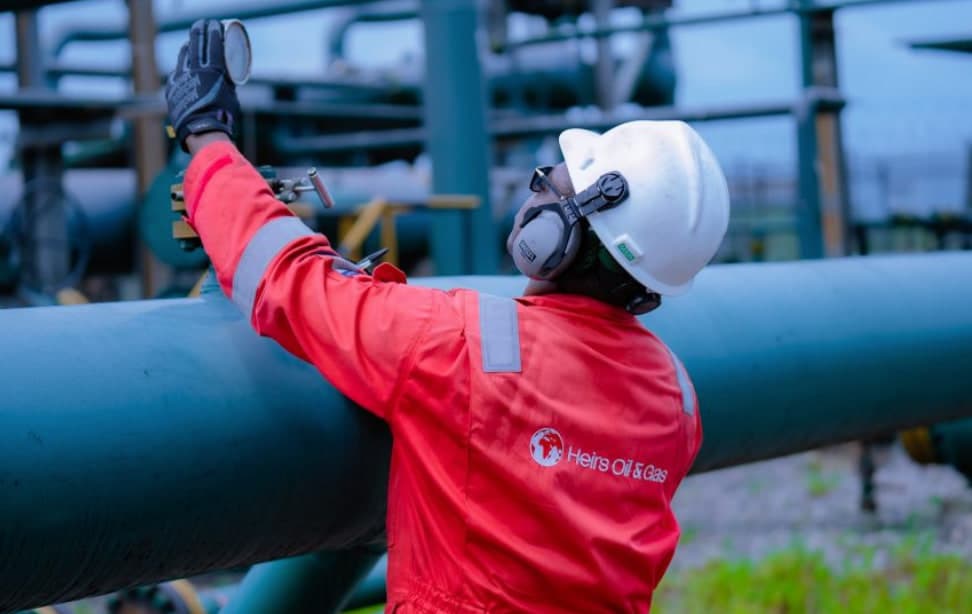
Heirs built an Integrated Operations Management Centre, or IOMC, to bring information from across the operation into one place. The centre receives data from wellheads, flow stations, gas plants and pipelines. Engineers can monitor pressure, flow rates, temperatures, production volumes and other readings remotely. That may sound straightforward. In an oilfield spread across more than 1,200 square kilometres, it is less so. Before this kind of setup, a problem could depend on someone seeing it in the field and reporting it. With the monitoring system, engineers can spot changes in the readings and decide whether somebody needs to be sent out. Fidelis Akpoghiran, Heirs Energies’ senior vice-president for business transformation and improvements, is careful not to present the system as a solution on its own. “Technology is an enabler,” he said. That is probably the most useful way to look at what Heirs has built.
The centre cannot repair a broken valve. It cannot stop someone from stealing equipment. It cannot fix a pipeline. It can tell the people responsible for the operation that something has changed. The quicker they know, the quicker they can decide what to do.
The wellheads needed watching too
Heirs also put intrusion-detection systems around producing wellheads. The systems combine touch-sensitive fencing, cameras and monitoring equipment. They are intended to pick up unauthorised attempts to get into a facility or interfere with its equipment. The company says it recorded around 50 attempted or confirmed intrusion incidents between July 2021 and December 2024. After most producing wells were covered by the detection system, Heirs says it recorded no such incidents from January 2025.
There is still a human step between an alert and a result. According to the company, security personnel can be mobilised in about 10 minutes after an alert. So if the system detects someone trying to get into a facility, it is the response afterwards that determines what happens. That is also why it is difficult to separate the effect of the technology from the security operation around it.
The oil started coming back
Production has changed considerably since Heirs took over. The company says oil output has risen from about 25,000 barrels per day to more than 50,000 barrels per day. Gas production has gone from roughly 50 million standard cubic feet per day to at least 120 million standard cubic feet per day. Some of that gas is going to the domestic market, including the 188MW Geometric Power Plant in Aba.
Ayodele Oni, partner and chair of Bloomfield Law Practice’s energy and natural-resources group, sees another part of the production increase as important: Heirs has been working on existing wells instead of relying entirely on new drilling. “Get more out of what’s already in the ground and already built before spending big on new wells,” he said. That approach makes sense for an old asset where some of the infrastructure is already there. But it also has a limit. Heirs wants to reach 100,000 barrels per day. Getting from more than 50,000 to that level will require continued work on the fields.
The pipeline problem has not gone away
The original problem with OML 17 was not simply production. It was the route between production and the market. That remains a risk. A well can be producing normally while a problem somewhere along the evacuation network prevents the crude from getting to the terminal. Oni also points to another issue with the gas business: payment.
Heirs can supply gas to power plants, but the plants still have to pay for it. Problems elsewhere in Nigeria's electricity market can therefore reach back into the upstream business. Then there is the money required to keep developing the fields.
In December 2025, Heirs secured a $750 million financing package from Afreximbank to support its capital structure and field-development plans. The company is also working on a project to capture flare gas. Heirs and NNPC say it could capture around 180 million standard cubic feet per day, with commissioning targeted for the third quarter of 2026.
AI is not going to fix the pipeline
Heirs is now looking at AI-assisted operations. But the company has spent years on something less fashionable first: collecting and organising its operational data. Akpoghiran said Heirs has built a real-time data historian covering its wells, flow stations and gas facilities. “You don’t do analytics in the absence of data,” he said. That is where the company is starting.
The data has to be collected. Someone has to be able to see it. Engineers need to know what a change in the numbers means. Only then does it make sense to add more advanced analytics. And none of that changes the physical nature of OML 17. There are still pipelines in the ground. There are still wells to maintain. There are still facilities to secure. There are still customers that need to pay for gas.
Technology gives Heirs another way of keeping track of those things. It does not make them disappear. For a company that spent $1.1 billion taking over OML 17, that may be the more immediate job: keep the wells producing, keep the equipment working and, most importantly, keep the oil moving all the way to the terminal.