Could a Cyberattack Bring an African Mine to a Standstill?
The more connected and automated African mining becomes, the more exposed it is to cyber risk. As mines rely increasingly on digital systems to control production, monitor equipment and regulate processing conditions, a cyberattack could do more than disrupt office networks or compromise business data.
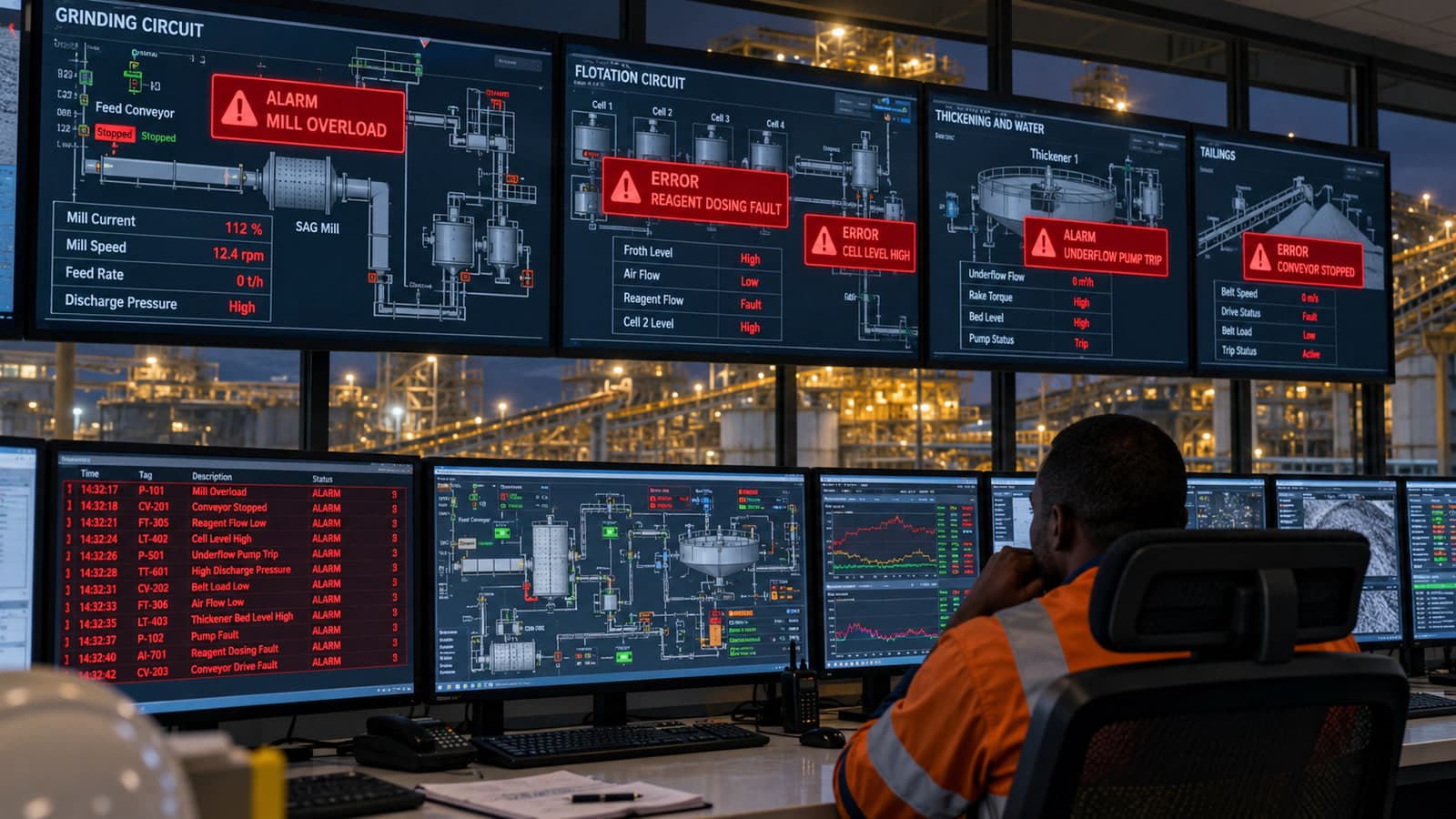
Mining Control Room Alarm Response
The more connected and automated African mining becomes, the more exposed it is to cyber risk. As mines rely increasingly on digital systems to control production, monitor equipment and regulate processing conditions, a cyberattack could do more than disrupt office networks or compromise business data. Cybercriminals who gain access to the wrong production system could alter operating settings, interfere with equipment or disrupt a process while the plant continues running. For mines that depend on automation to maintain production, the consequences could extend beyond lost revenue and damaged equipment to the safety of workers on site.
There is a dangerous assumption that complex mining systems are somehow beyond the reach of cybercriminals, or that existing security measures are enough to keep them safe. But what happens when an attacker gets access to the systems controlling a processing plant, changes critical operating parameters or interferes with equipment? The consequences could extend beyond lost production and financial damage. In the wrong circumstances, a compromised system could put workers' lives at risk.
When Hackers Reach the Production Floor
Modern mines rely on programmable logic controllers (PLCs), supervisory control and data acquisition (SCADA) systems, and distributed control systems (DCS) to monitor equipment and manage industrial processes. These technologies help operators regulate processing conditions, control equipment and keep material moving through the plant.
If an attacker gains unauthorised access to these systems, the consequences could emerge in the production circuit itself. Unauthorised changes to operating parameters could affect the stability of a process, disrupt the balance between different stages of treatment or push equipment beyond its intended operating conditions. In mineral processing, this could affect throughput, recovery rates, product quality and equipment performance.
For example, a plant experiencing unexplained changes in its operating conditions might see recovery deteriorate or production slow while engineers investigate the cause. If monitoring systems have also been compromised, operators could struggle to establish whether the readings accurately reflect what is happening on the plant floor.
The risks are not confined to processing. Mines also depend on digital controls for pumping, ventilation, conveyors and other essential functions. An attack affecting these systems could interrupt material movement, compromise essential services or create unsafe conditions. The actual consequences would depend on which systems were accessed, the level of control obtained and the safeguards still operating.
How an Attack Could Get Inside
Mining companies increasingly use remote monitoring, connected equipment and external service providers to manage operations. These connections improve access to operational data, but poorly secured connections can also expose systems to attackers.
A stolen password, compromised office computer or unsecured remote connection could provide an entry point into a company's network. If corporate IT systems and operational technology are not properly separated, an attacker may be able to reach systems that control physical processes.
The challenge is knowing how far an intrusion can travel. Access to a company's business network does not automatically give an attacker control over its processing plant, but weak network separation and excessive access privileges can increase that risk.
Detecting an Attack Before Production Suffers
Mining companies need to restrict access to critical control systems, separate corporate networks from operational technology where possible, monitor unusual activity and maintain secure backups of system configurations. Recovery procedures also need regular testing.
Plant managers, process engineers, automation specialists and cybersecurity teams must work together to understand how digital interference could affect production and safety. A response plan should account for the possibility that an apparent equipment or processing fault could involve a compromised control system.
The difficulty is that a mine may initially respond to unusual plant behaviour as an operational problem. Engineers could spend time checking instrumentation, ore characteristics or mechanical equipment while the source of the disruption remains unidentified. If an attacker has interfered with the control system, that delay could allow production losses to mount and make it harder to determine which readings and settings can still be trusted. For a mine operating on tight production targets, the danger is not only that hackers could disrupt the plant. It is that the operation could continue running while its control systems can no longer be fully trusted.