
The Best IT Best Practices Introduction
Best practices assist firms in improving services, products, security, and efficiency while maximising investment value. Incorporating best practices into your organisation can be a challenging process, but it comes with significant time and money savings, as well as extra benefits such as: Best practices vary by sector of IT, therefore a project manager will have

The Best IT Best Practices Introduction
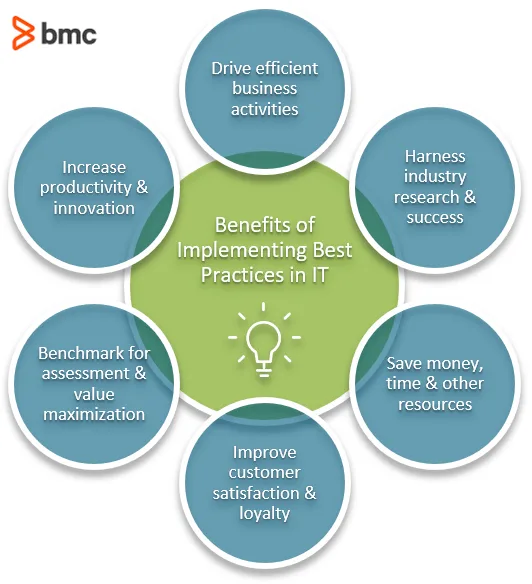
Best practices assist firms in improving services, products, security, and efficiency while maximising investment value. Incorporating best practices into your organisation can be a challenging process, but it comes with significant time and money savings, as well as extra benefits such as:
- increased productivity and efficiency
- Customers who are more satisfied and loyal
- Intentional creativity
Best practices vary by sector of IT, therefore a project manager will have a different set of best practices than a developer working on the mainframe, for example. Yet, this does not mean that they do not have considerable overlap.
Identifying the best practices for you is critical for your company’s success—and for your clients and customers to get the most out of the services you provide. This collection of best practices ranges from cloud computing to mainframe development and beyond.
What are best practices?
Gartner, a leading technology analysis organisation, defines best practices as:
A collection of tasks designed to improve the efficiency (cost and risk) or effectiveness (service level) of the business discipline or process to which it contributes. It must be transferrable, repeatable, and flexible across sectors.
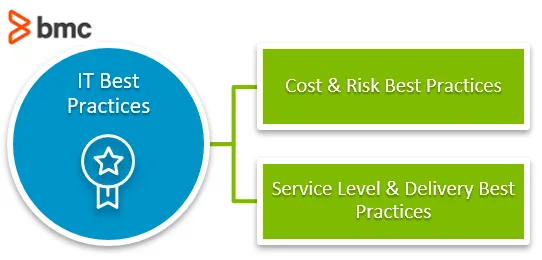
Gartner distinguishes two types of best practices: those that target cost and risk and those that address the business at the level of service delivery. Having systems and practices in place for both is critical to your company’s success.
However, keep in mind that implementing best practices is not the aim. Instead, you should follow best practices that will benefit your firm in specific ways and provide precise results.
Best practices for cost and risk
Project cost management is critical to corporate success. You’ll overspend on your projects if you don’t use good cost management and planning, and you’ll have to renegotiate the proper payment—or risk losing money where you’re intended to make it.
It is impossible to reduce costs or risk overruns without effective and efficient best practices.
Implementing simple cost and risk management best practices in your organisation will lower the risk of:
- Overspending
- Overrunning deadlines
- Unhappy customers
Like with other best practice implementations, the benefits may not be immediately apparent, but they will be noticeable in the long run. Hopefully, you’ll see changes in how your company:
- Delivers your products and services
- Honours agreements
- Brings value to customers
Best practises for service levels
Many service level agreements (SLAs) fail because they are not properly executed. Even when a company has the greatest service management procedures in principle, implementing SLAs may be tough. Failure to adopt best practices at every step will result in people failing to fulfil their obligations or misunderstandings later in the project.
Implementing a solid SLA from a reputable ITSM framework such as COBIT or ITIL is one of the simplest methods to achieve success. Although the agreements themselves will vary from contract to contract, understanding best practices will help you and your client succeed.
Are excellent practices always the same?
Best practices are there to enlighten us about how to get the most out of our money, service delivery, and customer support, rather than to be hard and fast regulations to butt up against. This indicates that best practices are somewhat adaptable.
To get the most out of them, you must first grasp best practises. How can you use a best practise in a way that benefits both the company and the client?
As the focus shifts from “These are the rules we must follow” to “How can we all maximise value?” best practises will become central to every business conversation.
Benefits of Using IT Best Practices
Of all, the ultimate purpose of best practises is to drive business operations that add value to your consumers’ lives. IT best practises can also be utilised for benchmarking and self-assessment. They are also the foundation for all prominent IT and service management frameworks, regardless of IT area.
Best practises go beyond templates and hard-and-fast regulations, instead concentrating on:
- Positive commercial consequences
- Effective adaptation of previously valid rules
- IT best practises aid the company.
- IT is increasingly moving away from only supplying technology to the company and towards offering and generating business value. Is your IT capable of the job?
BMC Blogs contains a wealth of tools for learning about and adopting IT best practises. Browse our individual blogs or go further into the following topics:
IT Operations & The IT Organization
Service Delivery & Management (ITSM)
Service Desk
Mainframe
Security
Cloud
DevOps
Data
The Business
Source: Austin Miller