South Africa's Internet traffic has increased by 500,000%
Internet traffic passing through South Africa's largest Internet exchange, NAPAfrica, has increased by more than 500,000% in just over a decade. Teraco, Africa's largest data centre operator, established NAPAfrica in March 2012 as a vendor-neutral Internet exchange point for South Africa. It enables organisations with Internet-hosted content and services to peer locally by deploying equipment

South Africa's Internet traffic has increased by 500,000%

Internet traffic passing through South Africa’s largest Internet exchange, NAPAfrica, has increased by more than 500,000% in just over a decade.
Teraco, Africa’s largest data centre operator, established NAPAfrica in March 2012 as a vendor-neutral Internet exchange point for South Africa.
It enables organisations with Internet-hosted content and services to peer locally by deploying equipment in Teraco’s router server facilities.
Customers are not required to pay membership, port, or cross-connect costs when peering.
Organizations only pay for the space and gear they rent in Teraco’s data centres, while they are welcome to provide their own.
NAPAfrica had just five peers at the time of its debut and observed peak data traffic of roughly 532Mbps.
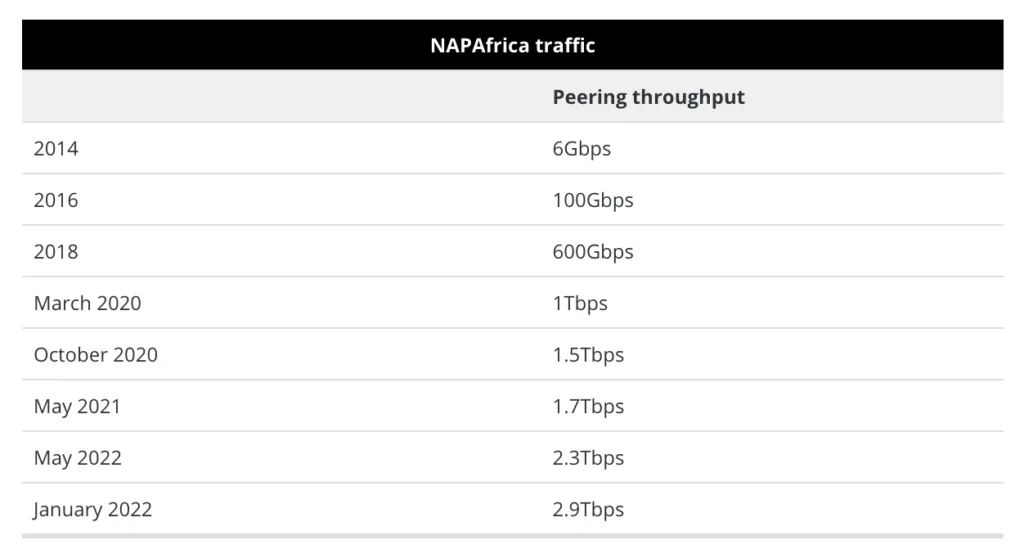
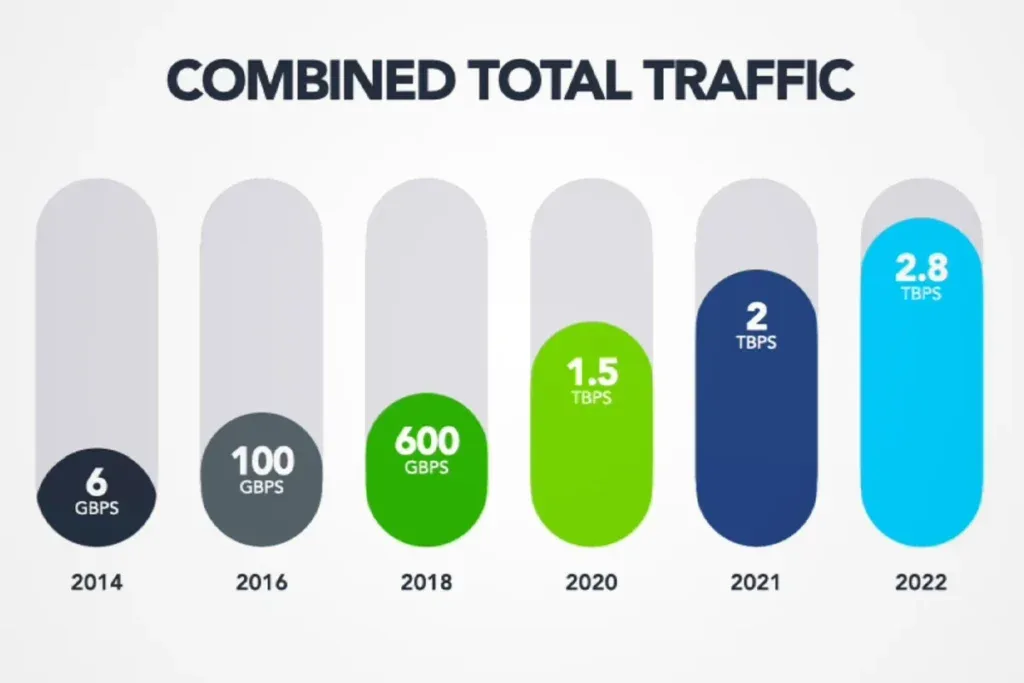
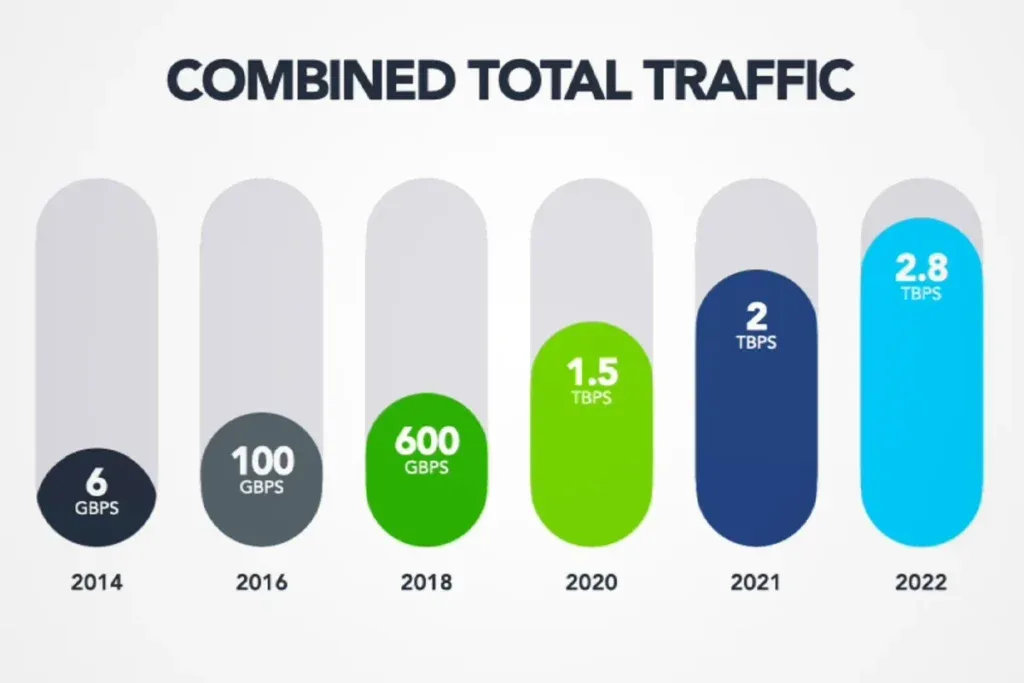
Over two years later, in 2014, around 100 firms were peering at the exchange, with a peak throughput of roughly 6Gbps.
This meant that data traffic has increased about 12-fold in two years.
However, by 2016, throughput had nearly tripled to 100Gbps, representing a roughly 17-fold growth, while peering members had also increased.
That was also the year Netflix officially launched in South Africa.
Terabit years start now
During the Covid-19 epidemic, the exchange broke beyond 1Tbps for the first time during the commencement of the country’s first severe lockdown in March 2020.
Peak peering throughput had increased by more than 50% to 1.5Tbps by October 2020. It progressively increased and will surpass 2Tbps by the end of 2021.
By the end of January 2023, traffic throughput had nearly doubled, reaching a peak of 2.87Tbps.
This marks a massive increase of more than 560,000% over the 532Mbps throughput observed during NAPAfrica’s start.
The table and infographic below illustrate the rise of peering traffic through NAPAfrica between 2014 and 2023. Because they were measured on separate days, the exact values may change significantly.
South Africa’s internet infrastructure has grown considerably in recent years.
Households now have access to faster fibre Internet connections, while cellular network consumers are consuming growing amounts of mobile data.
NAPAfrica warned MyBroadband that it may witness an increase in the number of individuals going online every day.
Its network traffic has increased due to an increase in peering members from 100 in 2014 to 575 by the end of January 2023.
The graph below depicts the growth of NAPAfrica’s membership from 2014 to 2022.
The sorts of material that Internet users consume also have a role in the growing traffic.
Video streaming services have made a significant contribution in this area, as delivering video over the Internet requires a large amount of data.
According to NAPAfrica, Internet users now have many more alternatives than simply well-known services like Netflix and Showmax.
Several streaming services have launched in South Africa in recent years, including Amazon Prime Video, Apple TV+, Britbox, eVOD, and SABC+.
Furthermore, large corporations were rapidly spreading their data and systems out of cloistered areas as they became immersed in the online community.
Peering locally enables IT titans such as Apple, Google, and Microsoft to provide software updates and other services to South African clients more quickly.
NAPAfrica stated that it does not foresee a repetition of the traffic surge seen during the Covid-19 outbreak, but that traffic will continue to rise.
It hopes to reach a 3Tbps traffic milestone by the end of the year, which would be three times the high experienced during the onset of the Covid-19 outbreak.
NAPAfrica offers an online data site that gives a snapshot of traffic across its Internet exchanges in Johannesburg, Cape Town, and Durban.
While it does not represent all Internet traffic passing via South Africa’s networks, it does show the overall trend.