South Africa's 2023 fibre pricing war, Openserve destroyed
Due to recent modifications in South African fibre network operator (FNO) speeds and price, Openserve is now the most costly residential fibre provider across practically all line speed categories. This is a significant departure from the previous two years. In 2021, Openserve's speed enhancements and pricing reduction made it the cheapest provider, setting the tone

South Africa's 2023 fibre pricing war, Openserve destroyed
Due to recent modifications in South African fibre network operator (FNO) speeds and price, Openserve is now the most costly residential fibre provider across practically all line speed categories.
This is a significant departure from the previous two years.
In 2021, Openserve’s speed enhancements and pricing reduction made it the cheapest provider, setting the tone for a series of fibre-to-the-home (FTTH) package overhauls from its competitors in the months that followed.
For a long time, it competed effectively on price, notably with its low-cost entry-level 25Mbps bundle.
Nevertheless, with the most recent changes, Openserve has slipped behind other major FNOs such as Vumatel, Frogfoot, MetroFibre, and Octotel across the majority of package tiers.
MetroFibre recently slashed pricing on its 500Mbps and 1Gbps packages and discontinued the 200Mbps plan, replacing it with a 400Mbps option at no extra cost.
On the negative side, it raised the wholesale price of its 50Mbps service and is scheduled to raise the price of its 100Mbps service later this year.
Nevertheless, Metrofibre is planning more price increases, as well as other modifications that will be disclosed in March 2023.
Frogfoot and Octotel have likewise boosted the speeds of the majority of their FTTH solutions. Although this resulted in certain pricing rises, the price-per-megabit of packages improved.
In comparison to its competitors, Openserve’s speed improvements were quite modest.
Comparison of prices per megabit per second
We compared the most recent accessible tariffs from these FNOs to Afrihost, one of the country’s largest fibre ISPs.
With the recent package rearrangement, comparing package costs amongst FNOs has become increasingly complicated.
Each FNO provides a unique mix of package speeds, and some have chosen unusual configurations rather as the standard 50Mbps, 100Mbps, 200Mbps, and 500Mbps possibilities.
While Frogfoot still provides 500Mbps and 1Gbps bundles, it now also offers 75Mbps, 150Mbps, and 250Mbps line speeds.
Similarly, Openserve offers packages with download speeds of 150Mbps and 300Mbps, which are not standard speed options.
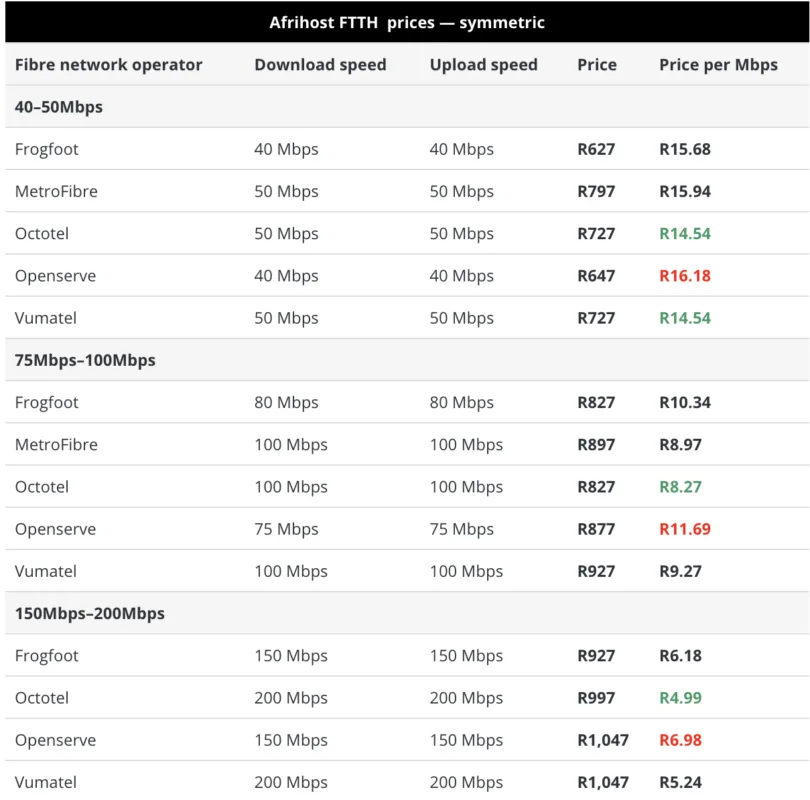
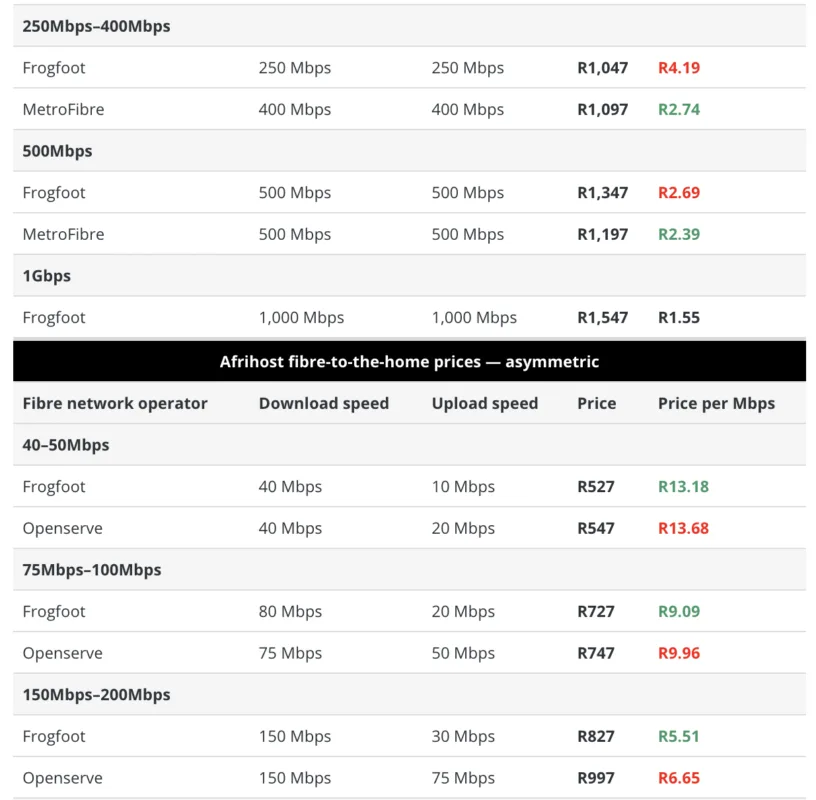
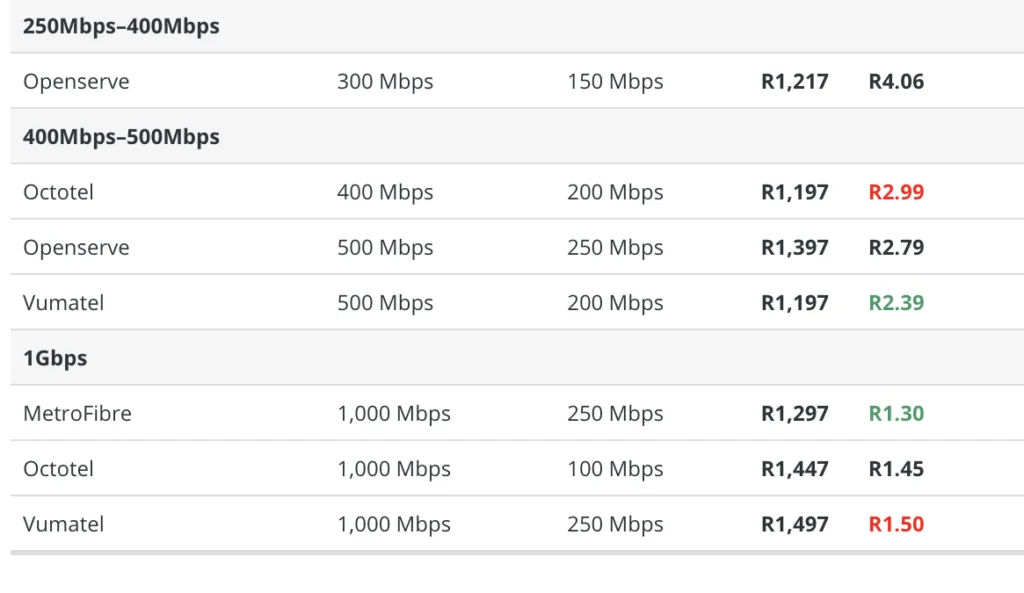
As a result, for a more practical comparison, we estimated the price per megabit per second within speed categories.
In six of the seven areas where it competed, Openserve was the most costly alternative.
The least expensive solutions for each category differed across the remaining FNOs.
The costs of Afrihost’s symmetric and asymmetric FTTH packages on the networks of Frogfoot, MetroFibre, Octotel, Openserve, and Vumatel are compared in the tables below.
The most cost-effective packages are highlighted in green, while the least cost-effective are highlighted in red.