
South African provinces with a higher proportion of unemployed people than employed people
Despite rising interest rates and fuel prices, as well as worsening load shedding, South Africa's unemployment rate fell in the third quarter of 2022. According to Statistics South Africa's latest Quarterly Labour Force Survey (QFLS), which was released on Tuesday (29 November), official unemployment fell by one percentage point from 33.9% in the second quarter

South African provinces with a higher proportion of unemployed people than employed people

Despite rising interest rates and fuel prices, as well as worsening load shedding, South Africa’s unemployment rate fell in the third quarter of 2022.
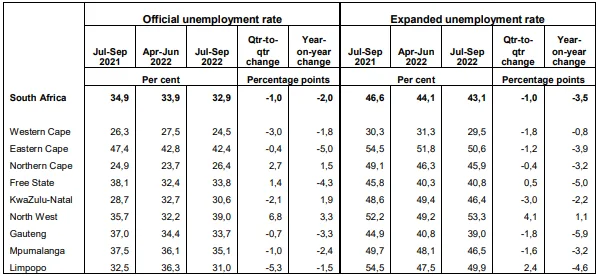
According to Statistics South Africa’s latest Quarterly Labour Force Survey (QFLS), which was released on Tuesday (29 November), official unemployment fell by one percentage point from 33.9% in the second quarter of 2022 to 32.9% in the third quarter of 2022.
This is the lowest unemployment rate in six quarters, with the number of unemployed people falling by 269,000 to 7.725 million and employment rising by 204,000 to 15.765 million.
The data show that the number of employed people decreased in three provinces between Q2 2022 and Q3 2022, with Gauteng, Western Cape, Kwa-Zulu Natal, Mpumalanga, and the Eastern and Northern Capes being the exceptions.
The most significant job losses occurred in the North West (-66,000), Limpopo (-55,000), and the Free State (-9,000).
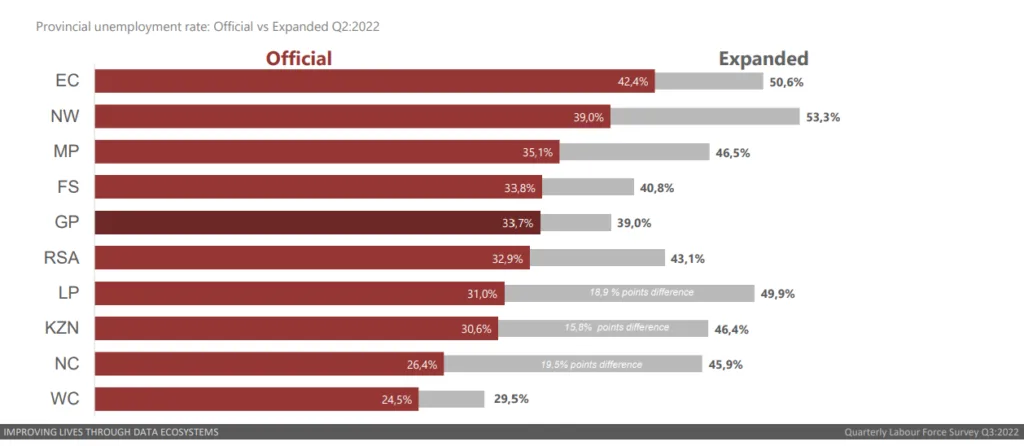
According to the most recent unemployment data, there are now two provinces in South Africa with an expanded unemployment rate of more than 50%, with Limpopo trailing at 49.9%.
These two provinces are:
- The North West (52.2%); and
- Limpopo (54.5%).
The reality is still discouraging.
Despite the QLFS’s positive trend, total employment remains lower than pre-Covid levels. According to Bureau of Economic Research economists, employment levels are still about 600,000 (4%) below pre-Covid (2019Q4) levels.
According to PSG Wealth, while manufacturing (+123,000) and trade (+82,000) saw the largest increases in employment during Q3 2022, the overall decrease of 1% in the unemployment rate could be due to a data lag that represents workers who returned to the labour market following the pandemic as vaccination rates rose.
According to the QLFS, the industries with the greatest job losses were finance (-80,000), private households (-36,000), and mining and agriculture (-1,000 each).
According to Nedbank economists, while the decrease in employment is encouraging, given South Africa’s economic challenges, job creation is still lower than what was seen in Q2 2022.
“The manufacturing sector created the highest number of jobs, bouncing back significantly from a decline in the second quarter. These gains also occurred amid extensive power disruptions. Employment also increased in construction, trade, and community and social services, but the number of jobs added by these industries was lower than in the second quarter,” Nedbank said.
Nedbank also stated that the job market outlook remains uncertain due to the current headwinds.
“Business confidence deteriorated further, with the RMB/BER Business Confidence Index remaining below the neutral 50-level for the sixth consecutive quarter in the fourth quarter, falling to 38 – its lowest since the second quarter of 2021.
“The deterioration reflected a combination of global and local unfavourable factors. Internationally, the key concern is the impact of slowing global growth which will hamper the performance of export-orientated industries,” the bank said.
Locally, poor labour market conditions, such as frequent strikes, high wage demands, high input costs, and power shortages, continue to discourage private sector investment, limiting job creation.
According to central bank deputy governor Rashad Cassim, South Africa’s economy must grow at a rate of 5% for several years in order to create jobs and reduce the country’s high unemployment rate.
Accelerating growth to 5% may be difficult for an economy that has grown at an average rate of 1% over the last decade and is hampered by rolling power outages, labour unrest, and transportation bottlenecks.
Going from a 1% economy to a 3% economy isn’t difficult for South Africa, according to Cassim. “Unfortunately, 3% stimulates the economy but does not reduce unemployment.” To reduce unemployment, we need 5% growth every year, which is a different debate.”
Adriaan Pask, CIO of PSG Wealth, added that the private and public sectors must accelerate the implementation of structural and pro-business reforms to unlock investment, reduce costs, and increase competitiveness and growth, which will go a long way toward creating sustainable employment.