No Free Lunch Podcast - Delays in Electricity Tariff Implementation Hurting Metal Manufacturing
In an exclusive interview by Greg Stewart with Konstantin Sadovnik, the CEO and board chair of Trans Alloys - they discuss South Africa's last manganese smelter electricity costs, a pending tariff arrangement with Eskom, and unnecessary delay's at NERSA to proceed with the implementation.
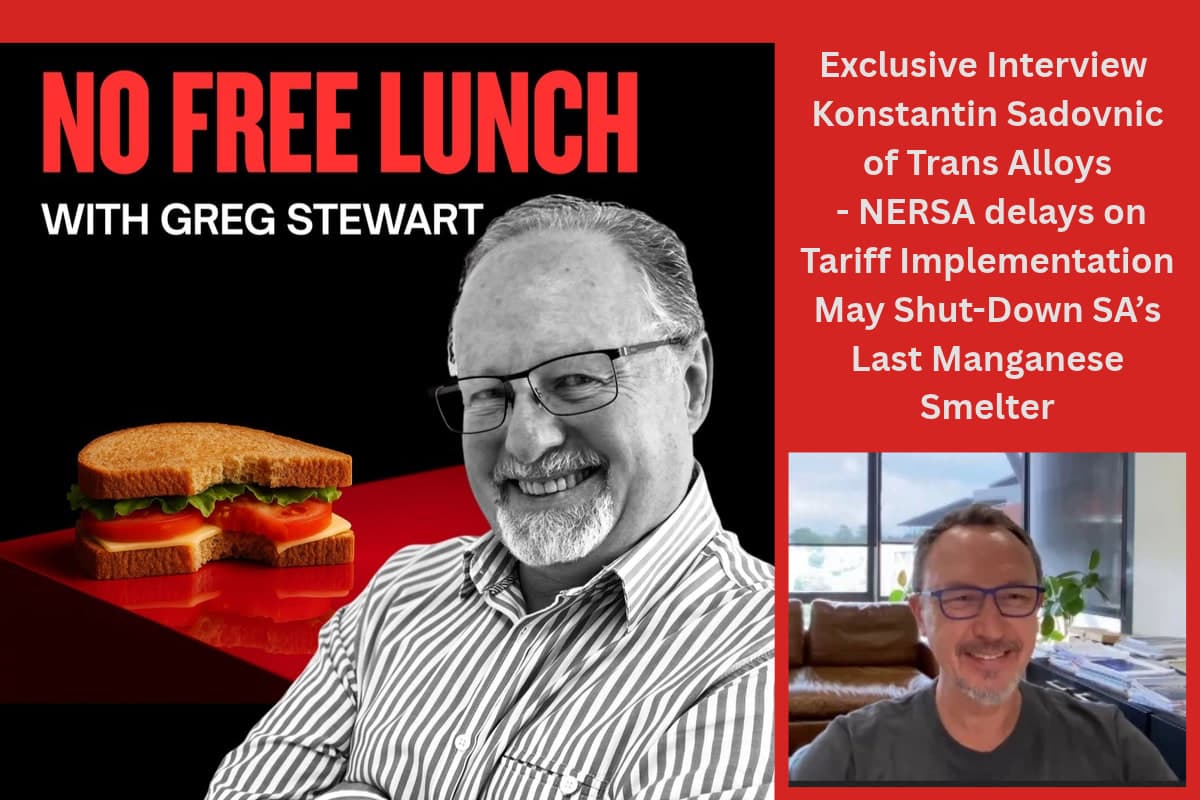
Trans Alloys CEO on Electricity Costs and the Fight to Keep South Africa's Last Manganese Smelter Open
Greg Stewart interviews Konstantin Sadovnik, CEO and board chair of Trans Alloys, South Africa's last manganese smelter. They discuss electricity costs, a pending tariff arrangement with Eskom, and the unnecessary delay's at NERSA to proceed with the implementation. The situation now has escalated and creates risk to about 600 jobs as well as the end of manganese processing in the country which earns significant income from the industry. The company is in Mpumalanga, uses Northern Cape manganese ore, and has capacity of around 155,000 to 180,000 tonnes a year, which is the last remaining processed manganese supplier in an industry that once used to process over a million tonnes per year.
Watch The Podcast Here:
Electricity costs and industry decline
Greg says Eskom's charges rose about 927% over ten years. Konstantin confirms that above-inflation increases made smelting unviable. He says South African capacity fell from roughly 1.2 to 1.5 million tonnes to around 160,000 tonnes. He adds that Trans Alloys has lost millions of dollars annually for about four years.
The Eskom tariff arrangement
Konstantin indicated that the company negotiated with Eskom from December 2025, and, after nearly a year, reached a tariff arrangement that could help it survive. He says it is not the 62 cents a unit that Greg mentions for the ferrochrome industry but is sufficient to ensure an ongoing successful industry in South Africa. The agreement now awaits NERSA's regulatory process,
Delay at NERSA
Konstantin says more than four weeks passed without NERSA opening a public hearing, compared with seven days in a ferrochrome case. He says no one has asked Trans Alloys for additional information during the delay. Eskom also confirmed that it submitted requested information by November 6. Greg and Konstantin both criticize the slow process, and the interview reports no resolution.
Jobs and Company Finances
Konstantin confirms around 600 jobs are at risk. He says the company is running out of resources, banking lines have been suspended, and retrenchments may be necessary. Greg says the consequences would extend across the metals, steel and automotive industries, as well as suppliers, exports, foreign revenue and jobs. He also criticizes what he sees as government neglect of the manufacturing sector in general.
Investment and Beneficiation
Konstantin says Trans Alloys has production, technology and expansion plans. He says investment requires predictable electricity prices and other conditions. He notes that South Africa exports 25 to 26 million tonnes of manganese ore annually while local beneficiation remains limited.
Related stories
More on South Africa → opinion-analysis
A Decade of Decay Under Ramaphosa’s Watch – Could Have Delivered a Million Jobs and 115 000 Small Manufacturing Businesses
 Trade & Industry
South Africa’s Manufacturing Sector Contracts Further as ABSA PMI Declines
 energy