Jobs in South Africa with the highest average salary
Statistics South Africa's employment data indicates which workers in the country's formal, non-agricultural industries get the highest average wages. The Quarterly Employment Survey data from Stats SA covers eight key industries or sectors in South Africa, which are further subdivided into 20 sub-categories, primarily made up of various manufacturing sectors, as well as a split

Jobs in South Africa with the highest average salary
Statistics South Africa’s employment data indicates which workers in the country’s formal, non-agricultural industries get the highest average wages.
The Quarterly Employment Survey data from Stats SA covers eight key industries or sectors in South Africa, which are further subdivided into 20 sub-categories, primarily made up of various manufacturing sectors, as well as a split between the government and non-government community, and social services.
The entire dataset includes earnings estimates for 90 distinct job kinds in the formal, non-agricultural sector, indicating which job types or sectors receive the greatest monthly wages.
The QES data is an enterprise-based survey that collects information from around 20,000 non-agricultural firms and organisations.
According to the data, the average monthly wage in South Africa is currently R24,813 (up 0.6% from the previous quarter, when it was R24,668), and up 3.8% from the third quarter of 2021, when it was R23,908.
Employee total gross earnings climbed by R11.1 billion, or 1.4%, from R789.4 billion in June 2022 to R800.5 billion in September 2022.
According to Stats SA, this was mostly due to increases in business services, mining, commerce, manufacturing, and power.
There were, however, cuts in transportation, building, and community services.
Between September 2021 and September 2022, overall gross profits grew by R17.5 billion, or 2.2%.
Among the employed, agricultural employees, self-employed workers with unincorporated enterprises, unpaid family workers, and private domestic workers are excluded from the poll. Employees who perform several jobs and consequently appear on multiple payrolls are tallied individually for each appearance.
High-paying industries
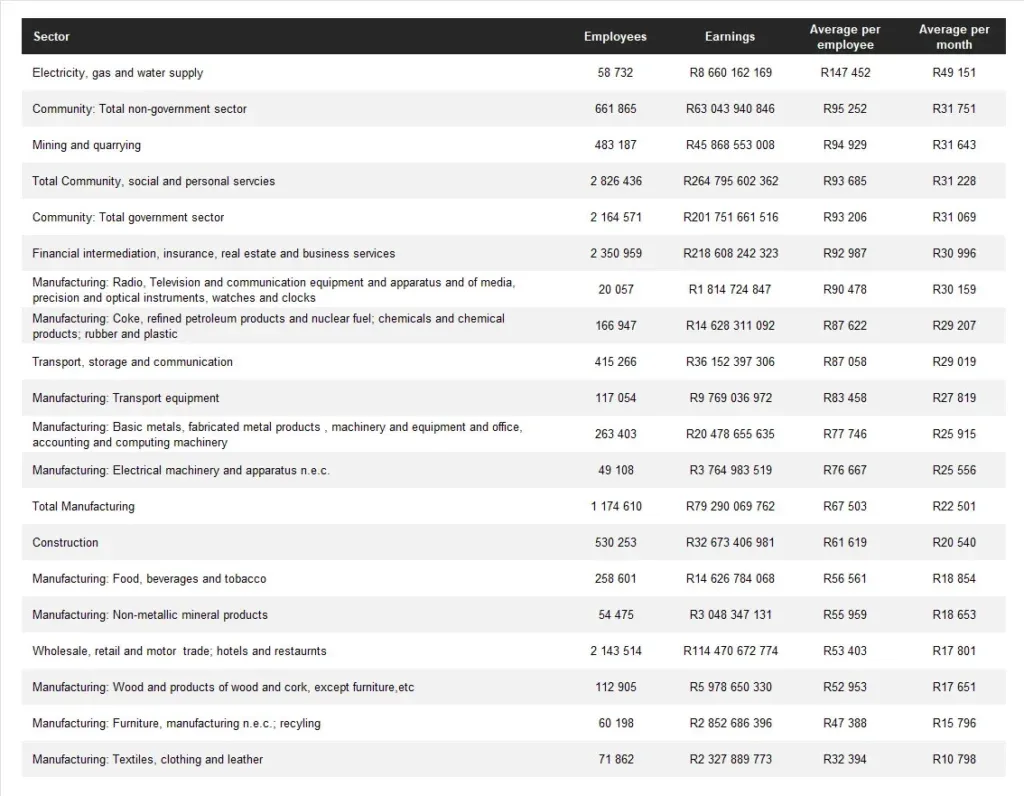
According to Stats SA, employees working in the electricity, gas, and water supply sectors receive the highest average monthly wage in the country, just under R50,000.
This is followed by individuals earning R31,750 per month in the non-government community sector. Healthcare employees are included in this industry. The mining and quarrying industries, as well as government employees, are not far behind.
The industry with the lowest earnings is textile manufacturing, where the average monthly income is little about R10,800.
Other low-wage industries include furniture makers and the wood and wood products sector.
Job classifications
Looking at more specific occupational statistics, Stats SA estimates that workers in financial intermediation earn the most in the country, with an average monthly pay of R66,750. This is followed by coke oven and petroleum refinery manufacturers.
Electricity and gas delivery are also highly regarded, as are jobs relating to computers and technology.
Workers in the textile manufacturing business, on the other hand, are the lowest-paid, earning just over R9,200 a month. This is lower than the pay of sawmill employees (R9,550) and other fabric workers.
Based on the most recent wages data from Stats SA, the table below highlights the top and lowest-paying employment sectors in South Africa. The following are the industry segments:
- Mining includes mining and quarrying
- Manufacturing includes food and beverages, furniture, textiles, wood, printing and publishing, petroleum and chemicals, non-metals and mineral products, electrical, medical and technology-related apparatus, and transport equipment
- Electricity includes gas and water supply
- Trade includes wholesale, retail, motor, hotel and restaurants
- Transport includes freight, storage and postal communication
- Business services include financial intermediation, banking, insurance and real estate
- Community includes social and personal services, split among government and non-government entities.