Extortion'mafia' strikes SA's nearly R1 trillion mining sector
A threatening letter, a derailed train, closed roads, burned vehicles, and workers imprisoned Extortion, according to some of the world's largest mining companies, is a problem in South Africa. Covid sent Africa's most industrialised country — home to the world's largest deposits of metals ranging from platinum to chrome and manganese — into its deepest
Extortion'mafia' strikes SA's nearly R1 trillion mining sector
A threatening letter, a derailed train, closed roads, burned vehicles, and workers imprisoned Extortion, according to some of the world’s largest mining companies, is a problem in South Africa.
Covid sent Africa’s most industrialised country — home to the world’s largest deposits of metals ranging from platinum to chrome and manganese — into its deepest economic contraction in more than a quarter century, leaving it with soaring inflation, one of the world’s highest unemployment rates, and a collapse of local government services.
Mining firms have been a rare bright spot in the global commodities market, making companies like Anglo American, Glencore, and Sibanye Stillwater targets for groups they claim are demanding up to 30% of their lucrative procurement contracts, often with little to offer in terms of skills and services. Noncompliance poses risks to executives and disrupts operations.
“The procurement mafia mobilises the community for their own devices, which is really very straightforward extortion,” Paul Dunne, chief executive officer of Northam Platinum, the operator of the world’s deepest mine for the metal, said in an interview.
While some groups claim to be fighting for social justice or Black economic empowerment by demanding a larger share of the pie from the predominantly White-owned mining companies, even the government admits that much of the relatively new, violent extortionist phenomenon is driven by gangs looking to make a quick buck. Mining companies, as well as Black-owned contractors, say they are increasingly dealing with syndicates that incite local communities to disrupt operations.
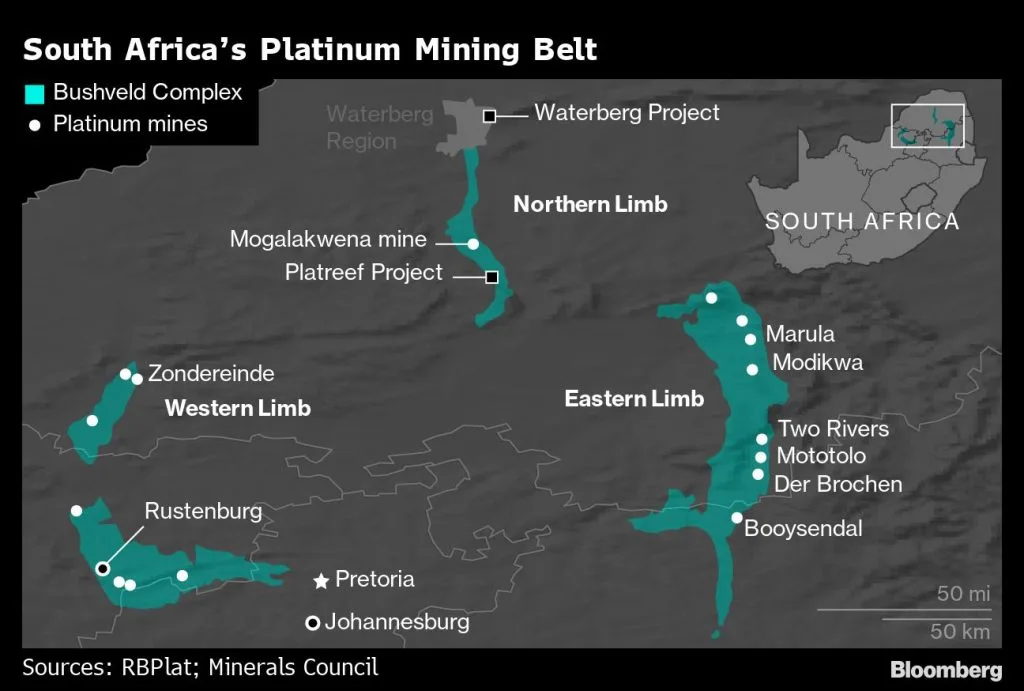
Bloomberg interviewed over a dozen mining executives, contractors, government officials, politicians, and protesting groups, as well as reviewed threats received by firms, to demonstrate why extortion, on top of onerous local-ownership rules, fractious labour unions, and erratic power supplies, is making South Africa a less appealing investment destination.
The country’s Department of Mineral Resources, which began efforts to revitalise the sector earlier this year, cited “community unrest” as a reason for “decreased appetite by private investors.”
Already last year, South Africa was ranked 75th out of 84 jurisdictions in Canada’s Fraser Institute’s Annual Survey of Mining Companies, a global industry benchmark, compared to 60th in 2020 and 40th in 2019. Few new mines are being developed, and little exploration is taking place, putting the country’s economy at risk. South Africa’s $55 billion (R949.85 billion)* mining industry accounts for 8% of GDP, roughly half of exports, and employs nearly half a million people.
Under attack
“The industry is under attack,” said Hennie Flynn, head of the North West Province wing of the Hawks, the South African police services’ directorate that targets organised crime, economic misconduct, corruption, and other serious illegal activities. The syndicates “are creating their own mafia-type groupings that exert pressure.”
The state-owned logistics firm Transnet said in November that a train derailed on the main export route for coal miners, “against a backdrop of threats and disruptions to the company’s operations by disgruntled groupings seeking business opportunities.” Efforts to restore normal services were blocked by the Ulundi Business Forum, which demanded contracts from the company, Transnet said, adding that the group resorted to “violent, extortion effort.”
The Ulundi Business Forum’s chairman, Musa Ngqulunga, denied any involvement in the derailment, but said the group was outraged by contracts awarded to a company from outside the region, saying “we can’t be spectators in our area.”
“We told Transnet that if you don’t give us a chance to work, we are going to close the site,” he said in an interview.
“We have only one weapon. We just stop the site, you can’t continue working. If you don’t give us a piece of the cake, that’s the solution. We just stop the site, that’s the way of making somebody understand better … the best way is to stop you until you cooperate.”
A local politician who gathered about 100 youths to demand jobs at the mine locked up about 15 workers with a mining contractor at Sibanye’s K3 platinum shaft for 12 hours in May, according to a company spokeswoman.
According to Northam Platinum’s Dunne, a radial road network in and out of a web of mines in the metals-rich Bushveld Complex in northern South Africa used by producers including Northam Platinum, Anglo American Platinum, Glencore, and Samancor Chrome has been blocked more than 140 times this year by groups demanding everything from contracts to jobs.
“What they are demanding is to be awarded contracts from the mines at any price, irrespective of their effectiveness or ability,” Neal Froneman, CEO of platinum, palladium and gold producer Sibanye, said in an interview.
“In the worst case, they demand part payment from people that have honest contracts, otherwise they disrupt their ability to deliver goods and services. Anyone that steps up to intervene is intimidated.”
The increasing gang attacks, which have also afflicted the construction industry, are quickly becoming an indictment of President Cyril Ramaphosa’s government’s inability to ensure the rule of law in the conduct of business.
“This is definitely the final nail in the coffin of investment,” James Lorimer, the main opposition party Democratic Alliance’s shadow minister for mineral resources, said in an interview. “I have no faith that the government is going to act coherently over time to bring down these problems. There’s no political will, that’s quite obvious.”
Ramaphosa is fighting for his political life after an independent panel’s report said he may have violated the constitution and questioned his handling of a $580 000 theft at his game farm in 2020, contradicting his claims that he’d done nothing wrong. The scandal may further erode his ability to address the country’s law and order issues.
Groups such as the Ulundi Business Forum and Banaef, which represents 72 Black-owned businesses, claim to be legitimately seeking a more equitable distribution of contracts. Companies on the receiving end of their demands disagree.
Consider the letter Impala Platinum Holdings received from a firm representing Banaef late last year. Executive Outcomes, led by an apartheid-era defence forces officer, said Banaef hired it to audit Impala’s procurement processes because the world’s third-largest producer of platinum was “suffocating some Black-owned companies.”
Letlhogonolo Mogopodi, Banaef’s secretary-general until mid-November, said in an interview that the letter was sent “to put pressure so that they can know that we cannot just be the affected host community and 50 years down the line, there’s nothing we can show for it.”
The letter, obtained by Bloomberg, was an attempt to persuade top Impala executives to redirect some contracts to Banaef members via a veiled threat from Executive Outcomes, which helped governments in Sierra Leone and Angola fight armed rebels in the 1990s.
“There’s definitely a tactic of syndicates organising communities to act on their behalf, always creating an impression that they are disenfranchised,” Nico Muller, the chief executive officer of Impala, said in an interview. “We’ve had some of the communities appointing independent auditors who wanted to audit us. And then when you look into the audit firms, they are not accredited.”
Mogopodi said Banaef hired Executive Outcomes because it wanted to see “if management at Impala benefits from the contracts meant for locals. Impala claims it’s spending money on local businesses. We have no mechanism to test that.”
Executive Outcomes’ website features an image of a combat-suited man in a tank and makes no mention of audit services; Eeben Barlow, the company’s CEO, declined to comment. Officials at Banaef stated that they were unaware of Executive Outcomes’ militia background.
“Are we using cartel-like behaviour in enlisting the services of mercenaries to get companies to implement transformative policies? I can equivocally say ‘no,’” said Ditebogo Diale, the group’s deputy secretary, adding that Banaef also took its case to a major Impala shareholder.
Did all the pressure work? “Yes, you could say there has been progress, but whether that progress is worth the paper that it was written on, that can only be seen by the numbers Impala puts out,” she said.
Impala did not respond to the Executive Outcomes letter. According to Johan Theron, an Impala spokesman, “often, groups demanding business want to provide products like diesel, explosives, or uniforms, which mining companies can get directly from the manufacturers at a much lower cost.”
“Most of the business practices are fronting,” Theron said. “If we buy from them we are not adding value to the economy in the communities, we are just making one person rich for doing nothing.”
Extortion is often associated with the hopelessness of desperately poor people struggling to make ends meet in circumstances exacerbated by the pandemic. Many mines are located in some of the poorest areas of the country, and the syndicates are capitalising on the resentment of impoverished communities afflicted by deteriorating services and joblessness.
Mining is the only economic activity in the North West Province, which contains the majority of the country’s platinum and chrome reserves. The roads are dusty and potholed, and the towns are run-down, with little more than a church, a liquor store, and a pawn shop. The government, which faces a party election this month and a general election in 2024, is pressuring mining companies to purchase more goods and services from Black South African-owned businesses.
For decades, mining companies have profited from rich veins of metals such as gold, platinum, and manganese. Some have included community trusts in Black economic empowerment transactions, in which a stake in assets is sold to members of South African ethnicities that were disadvantaged during apartheid.
A small group of Black businessmen, some of whom are politically connected, have reaped the most benefits from that effort. President Ramaphosa, who took stakes in Glencore and Lonmin assets during his time outside government, and his brother-in-law, Patrice Motsepe, South Africa’s only Black dollar billionaire, are among them.
However, little progress has been made in advancing Black South Africans to the highest levels of management. Only one South African mining company, Exxaro Resources, is represented in an index of the top 40 stocks traded in Johannesburg.
While the number of Black-owned businesses in the sector has grown, many smaller businesses are still excluded because they cannot afford the necessary machinery and equipment, according to Jonathan Leso, executive director of African Sun Mining, a Black-owned contractor. However, he claims that Black businesses are frequently targeted by gangs.
“The environment is little bit levelled-up, the reason being that people are no longer looking at who are you, they just want to know do you have the machines,” he said. “The biggest thing now is that if you’re not from that local area, it’s difficult to get any type of the job because the local communities are fighting that. If you’re not from the community, they block the roads, they burn the tires because they are forcing you to go into a joint venture with them.”
According to Tseliso Maqubela, a deputy director-general at the Department of Mineral Resources and Energy, approximately 90% of people or entities requesting business from mining companies are not registered.
“Some of them think they can just go to a mining house and demand to be given a contract,” he said.
Communities with high unemployment and a lack of basic services such as clean water are now looking to mining companies for solutions, according to Natascha Viljoen, CEO of Anglo American Platinum, the world’s largest platinum producer by market value.
We are “picking up additional costs to do business,” she said in an interview. These are needed to ensure “stable operations and to make sure that we can run our businesses uninterrupted,” she said.
Security costs have risen, and Impala alone has about seven ban orders against various groups interfering with its operations, according to a person familiar with the situation who did not want to be identified for fear of being attacked.
According to the person, one group is currently threatening to burn buses used to transport employees to the mine unless it is awarded contracts. Security guards were hospitalised after being beaten, vehicles and guard cabins were set on fire, and procurement staff resigned after being threatened, according to mining companies.
“This is as bad as it has ever been,” said Roger Baxter, CEO of the Minerals Council South Africa, which represents most mining companies operating in the country.
Gold Fields had to cordon off its assets after groups asking for 30% of the value of some projects were turned down, according to Sven Lunsche, the company’s spokesman.
“We had to erect fencing around our tenement to keep people away,” Lunsche said. “We provided security to our procurement teams. We had to make sure they had bodyguards when they went home. Some of our senior managers were also threatened. Some are personal threats and you don’t take that lightly.”
Rio Tinto Group discovered how real such threats can be when Nico Swart, the general manager of operational services at its Richards Bay Minerals unit, was shot dead on his way to work last year. The motive for the killing is unknown, and those responsible have yet to be identified. The mine is still subject to intermittent harassment, according to the company, with sporadic shootings at buses carrying workers or stoning of vehicles.
“All our leadership still have to travel and live under very heavy protection, including myself,” Werner Duvenhage, managing director of the unit said in an interview. “You can’t really move around. Normal little things like going to shops or just going out for dinner, those are not normal things anymore.”
Producers are currently benefiting from higher metal prices, but this may not last, according to Sibanye’s Froneman.
“When the commodities cycle changes, it obviously impacts our margins,” he said. “We put jobs at risk because we now have taken on burdens that we’ve already paid for in terms of taxes and royalties.”