Africa is building AI with too little disability data
Francis Elendu carries two things when he leaves home in Enugu: his phone and his guide cane. The cane helps him move around, while apps such as Envision AI and Seeing AI help him identify things that the cane cannot pick up, including poles and objects in his path.
AI
Francis Elendu carries two things when he leaves home in Enugu: his phone and his guide cane. The cane helps him move around, while apps such as Envision AI and Seeing AI help him identify things that the cane cannot pick up, including poles and objects in his path.
AI-generated summary. It can miss nuance — read the full story above for the complete picture.
Francis Elendu carries two things when he leaves home in Enugu: his phone and his guide cane. The cane helps him move around, while apps such as Envision AI and Seeing AI help him identify things that the cane cannot pick up, including poles and objects in his path.
The technology helps. It also gets things wrong. Elendu says navigation apps sometimes struggle with Nigerian streets and surroundings. Some of the things the apps identify simply do not make sense in the environment he is in. He has wondered whether enough of the places outside Europe and the United States were considered when these products were developed.
His experience points to a problem that is easy to miss when talking about Africa's AI plans. There may be millions of people here who could use AI-powered accessibility tools, but the data used to build those tools does not always include them. More than 100 million Africans live with a disability. A 2025 study covering Ghana, Kenya and Rwanda found that people with disabilities are underrepresented in datasets used to train AI systems. It also found that existing disability data is fragmented and poorly mapped. That makes it difficult for researchers and developers to know what information is already available, what they can use and where the gaps are.
“If the data does not reflect the people using the technology, some of those products will continue to work better for some Africans than others.”
Nobody has a full map of the data
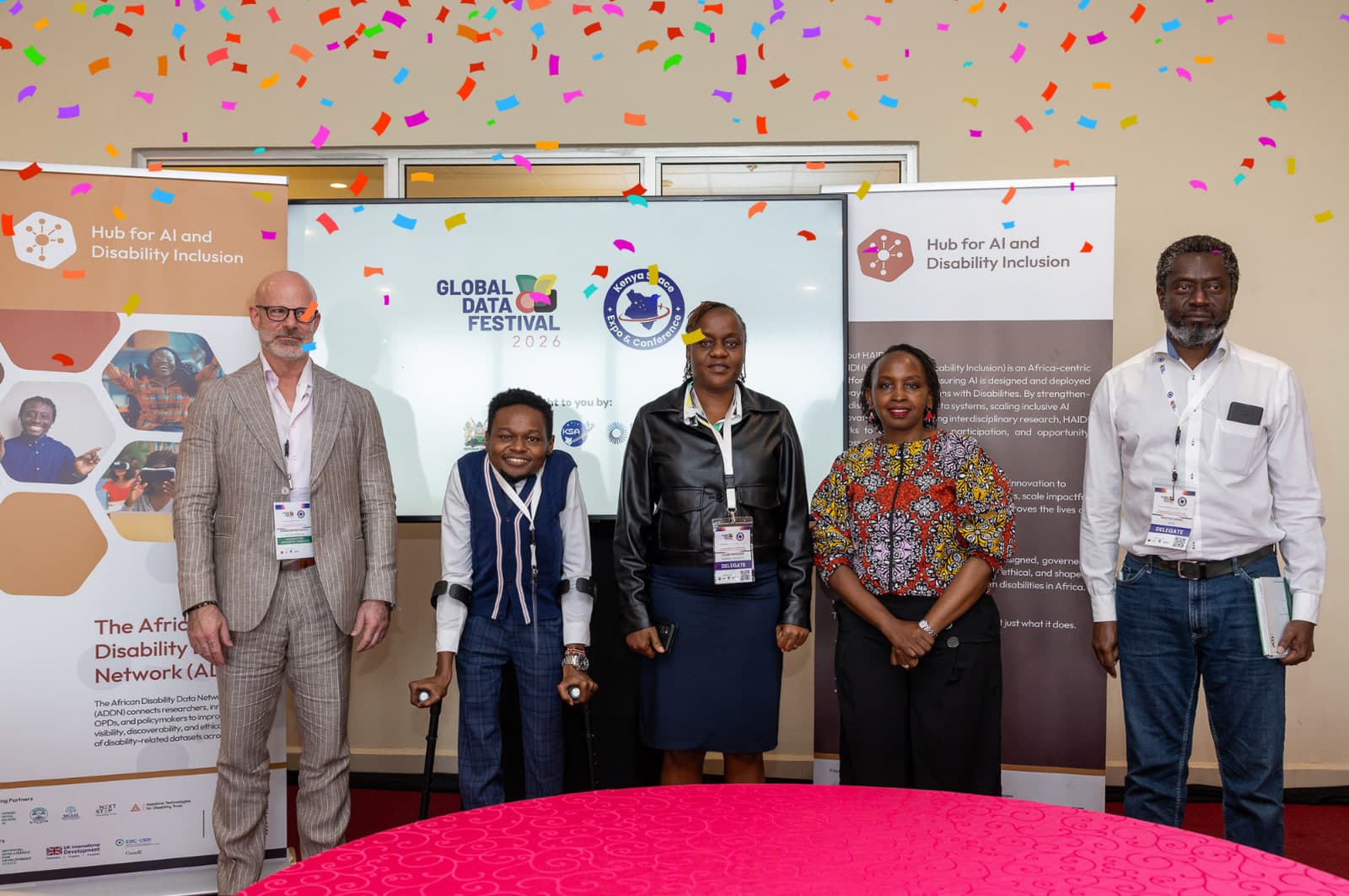
This is what the newly launched Hub for AI and Disability Inclusion (HAIDI) and African Disability Data Network (ADDN) are trying to address.
The two initiatives were unveiled at the Global Data Festival in Nairobi, with backing from the International Development Research Centre, the UK's Foreign, Commonwealth and Development Office and the AI4D programme. HAIDI will bring together researchers, disability organisations, technology companies, policymakers and other groups working in this area. ADDN is taking a more practical approach to the data itself.
It is being built as a network where researchers, startups and policymakers can find out what disability datasets exist and who controls them. The idea is not to move all of that information into one giant database. If a startup is building a sign-language translation tool, for example, it could use ADDN to find out whether a useful dataset already exists, identify the organisation holding it and approach that organisation for access. That may sound basic, but knowing where data sits is currently part of the problem.
African sign languages are one example
The shortage becomes clearer when looking at language. The AI4D study found major gaps in datasets covering African sign languages. Kenyan Sign Language has very little data compared with American Sign Language. The study also found that Kinyarwanda voice data involving people with speech impairments is almost non-existent in global datasets.
For someone building an AI product around one of these languages, the problem starts before the software does. There may not be enough suitable information to train the system properly. Even when datasets do exist, they may have been collected or labelled differently, making it harder to combine them for machine learning. HAIDI plans to develop three datasets aimed at some of these gaps. They will cover sign languages, health and inclusive employment.
But disability data is not ordinary data
Some of the information being collected will be highly personal. The health dataset will initially involve adults, with a focus on people aged 18 to 30. The work could eventually include younger participants, but only once the necessary parental consent arrangements are in place. The consortium says participants will give informed consent, personal information will be anonymised where possible, and projects involving people with disabilities will go through ethics reviews and relevant approval processes.
That still does not make the privacy question disappear.
Fola Adeleke, an AI governance and data protection expert, points out that some information can remain identifiable even after data has been de-identified. It depends on what is collected and how much of it there is. There is also the question of what happens when someone wants their information removed later. The consortium says participants can withdraw their data from the published dataset. But once information has been used to train an AI model, removing it can be difficult and may require the model to be trained again. That makes the agreement people give before their data is collected particularly important.
Users are already seeing the gaps
Abdulazeez Hamdallah, a disability advocate in Lagos who has a hearing impairment, uses AI and other digital tools regularly. He uses ChatGPT to write reports and messages, organise his ideas and prepare training material. He uses live captions on Google Meet and Microsoft Teams and transcription software such as Otter.ai for meetings.
But captions do not always keep up. Hamdallah says accents, fast speech and background noise can cause problems. Support for sign language is also limited. That can leave him sitting in a meeting where part of the conversation simply does not come through. For him, the people whose data is being collected should have a role in deciding how it is collected and managed. That is also the view behind the wider work of HAIDI and ADDN: disability organisations and people with disabilities should not only appear in the datasets. They should be involved in the process of producing them.
Startups are being brought into the work
The project is not stopping at research. The consortium has announced an 18-month programme for three startups building AI products for people with disabilities. The selected startups can receive grants of up to KES 5 million, about $38,600, together with technical and product support. They will also get opportunities to test their products with disability communities and connect with potential funders and partners. The areas covered include education, employment, mental health, caregiving and assistive technology. The commercial applications are fairly obvious. Better speech data could help build tools that cope with accents that current systems struggle with. More African sign-language data could help developers build translation and communication tools. Better employment data could help companies build systems that are less likely to overlook people with disabilities. But none of that starts with a clever interface. It starts with having the right information.
The work is only beginning
Over the next year, HAIDI plans to map disability datasets across Africa, build its three planned datasets, establish its governance structures and examine how disability inclusion is dealt with in national AI strategies.
There is still a lot that is unknown. The organisations behind the project do not yet have a complete inventory of disability data across the continent. They are still working out what exists, where it is held and where the largest gaps are. For people already using AI, those gaps are not theoretical. Elendu is trying to use his phone to understand what is around him.
Hamdallah is trying to follow conversations through automated captions. Whether the next generation of AI tools works better for people like them will depend, in part, on whether developers finally have enough local data to build around their experiences.