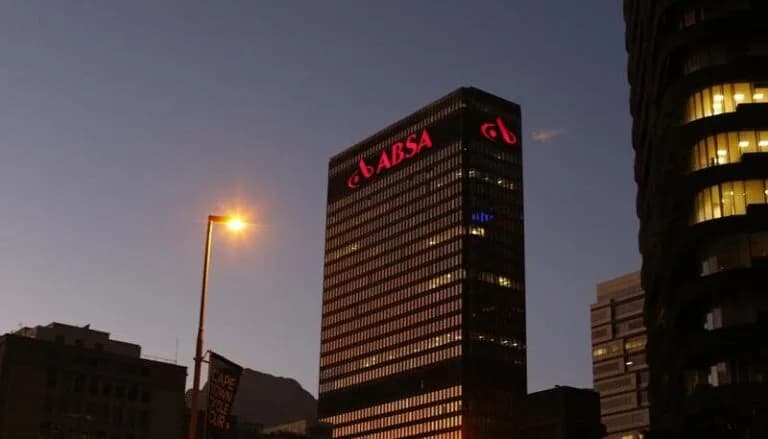
Absa bounces back, but is still losing customers
Absa Group reported a strong earnings rebound across its retail and business banking (RBB) franchises, when compared to the lockdown-impacted first half of 2020, but the group is still not adding customers. Customer numbers are 2% lower than a year ago, but the group says these have “remained stable at the December 2020 level of
Absa bounces back, but is still losing customers
Absa Group reported a strong earnings rebound across its retail and business banking (RBB) franchises, when compared to the lockdown-impacted first half of 2020, but the group is still not adding customers.
Customer numbers are 2% lower than a year ago, but the group says these have “remained stable at the December 2020 level of 9.5 million”. It says “the attrition witnessed in the second half of 2020, specifically in the entry level banking segment, was stemmed”.
Worryingly, the number of “primary customers” is down 3% from a year ago at 2.8 million. Absa says this is due to “lockdown restrictions in relation to the pandemic” which “continue to subdue transactional activity and reduce customer income”.
Headline earnings for its RBB unit are up over 600% from last year’s first half.
In fact, the bank’s retail unit made almost as much profit in the first six months as it did for the whole of last year (R4.052 billion versus R4.466 billion).
It says excluding provisions, profit contracted by 14% when compared to the first half of 2020. This “was driven by the impact of excess mortality claims, customer-centric fee decisions and increased costs related to incentives and restructuring costs”.
A more realistic comparison would be to the first half of 2019. Compared to that, earnings are 16% lower. The bank only provides selective comparisons to 2019 in its results.
| Headline earnings | H1 2019 | H1 2021 |
| Home Loans | R750 million | R1.368 billion |
| Vehicle and Asset Finance | R122 million | R240 million |
| Everyday Banking | R1.998 billion | R1.607 billion |
| Relationship Banking | R1.684 billion | R1.462 billion |
| Insurance | R584 million | (R297 million) |
| Total RBB SA (including other) | R4.847 billion | R4.052 billion |
Total income in its transactional banking segment (Everyday Banking) is down by R999 million from 2019, which resulted in a R391 million decline in profits.
Push on loans
Earnings growth in RBB is being driven by its deliberate secured lending push. Absa says the number of home loans registered “increased by 110% against 2020 and 47% against 2019” while the number of vehicle and asset finance loans granted “increased by 33% relative to 2019, in a market that shrunk by 10%”. Net advances for home loans totalled R257 billion, an 8% increase on the comparable 2020 period, with vehicle and asset finance totalling R94 billion, a 14% increase.
In 2019, Absa stated that its 2021 market share targets for retail deposits and retail banking advances were 22% and 23% respectively. As at end-June, these are at 21.8% and 22%, respectively. It is likely to fall short of those targets, despite respectable increases in both from 2019 levels.
Corporates are noticeably parking cash, with a 35% year-on-year increase in customer deposits (to R329 billion) in its South African corporate and investment bank. (In June 2019, this was R208 billion.) Absa says on the retail side of the bank, “growth in investment deposits was assisted by customer-led migrations from the Absa Money Market Fund post the announcement of its closure in April 2021”.
Its efforts at overhauling its RBB unit are yielding results. Absa says “process and product digitisation over the past two years have enabled the business to continue to drive efficiencies that have reduced the cost-to-income ratio to 56.8% relative to 2018’s 58.4%”. This is a meaningful decrease.
For the group, expenses are up 5%, mostly driven by a 6% increase in staff costs and 18% increase in technology expenses. Its cost-to-income ratio is 54.9%.
Unsurprisingly, Absa says the credit impairment charge was “significantly lower” at R4.7 billion (versus R14.7 billion in last year’s first half). The credit loss ratio for the group improved to 0.88% (with RBB’s at 1.33%). It says that “after last year’s substantial build in coverage, credit impairments are expected to decrease substantially, resulting in a credit loss ratio around the mid-point of our through-the-cycle range of 75 to 100 bps [basis points]”.
Absa says “whilst the cost of the looting, property destruction and trading interruption have been extensive and are being quantified, the longer term economic impact remains unknown”. It says 22 branches and 233 ATMs were “completely vandalised and a further 2 500 point-of-sale devices” were “stolen or damaged”.
The group reported (diluted normalised) headline earnings per share of 1 018.2 cents, a 487% increase on last year, but an anaemic 4% increase on H1 2019. The bank declared a 310 cents dividend per share. It “expects a dividend pay-out ratio of 30% for 2021, increasing to 50% over the medium term”.
Main Image: The Africa