
Pay cutbacks at the Post Office, while the CEO gets R4 million – it's past time to make tough decisions
The South African Post Office has said that it is overstaffed and that personnel expenditures must be reduced in order to avoid forced retrenchments. It responded in a statement to charges made by the DA's Dianne Kohler Barnard on Wednesday that the Post Office intends to effectively slash worker pay by 40% while CEO Nomkhita

Pay cutbacks at the Post Office, while the CEO gets R4 million – it's past time to make tough decisions

The South African Post Office has said that it is overstaffed and that personnel expenditures must be reduced in order to avoid forced retrenchments.
It responded in a statement to charges made by the DA’s Dianne Kohler Barnard on Wednesday that the Post Office intends to effectively slash worker pay by 40% while CEO Nomkhita Mona gets R4 million per year.
A credible source informed Kohler Barnard that Post Office management suggested decreasing staff hours by two days per week – an effective 40% salary decrease.
The South African Post Office (SAPO) has replied to her assertions, stating that it is facing a financial crisis.
“It is unsustainable for SAPO to carry staff expenses accounting for 68% of its expenditure,” it said.
“In fact, these decisions should have been taken a number of years ago, as the writing has always been on the wall. Staff cost reduction is unavoidable.”
Mona takes over as Post Office Group CEO on April 1, 2021.
According to the Post Office, numerous initiatives are being considered to cut employee expenses, including:
- A reduced work week — employees would be free to supplement their incomes in other ways, including within SAPO; and
- Voluntary severance packages, which is already underway.
“These measures are aimed at cutting employment costs, while saving some jobs — effectively a job-sharing model; while at the same time delaying a process of forced retrenchments,” said SAPO.
“SAPO has over the past number of years seen a substantial decline in letter volumes — which is in line with international trends — and a decline in revenue.”
While new goods such as car licence renewals help to compensate for this loss, the Post Office has always been overstaffed, according to the report.
“[This is] owing to a number of reasons, including the absorption of 8,250 temporary employees when labour brokers became undesirable; another 708 employees were absorbed from its courier division, Courier Freight Group (CFG), when it was dismantled.”
The Post Office employs 14,460 people, according to the most recent annual report.
If Mona’s income was cut to zero and distributed to the rest of the workers, everyone would receive R276 per year, or R23 each month.
If the pay of all executives, non-executive directors, and prescribed officers were decreased from R23.9 million to zero, the remaining 14,438 employees would each get an additional R138 per month.
SAPO also disputed Kohler Barnard’s allegation that Mona earned nearly twice as much as her predecessor, Mark Barnes, in 2020.
“The statement regarding the CEO’s remuneration is misleading,” it said.
“The 2020 annual report reflects the salary that the previous CEO received for the five months that he served during the relevant financial year,” said SAPO.
“The reality is that the current Group CEO earns less than her predecessor, even though she joined the organisation two years later.”
The analysis of the Post Office’s yearly reports supports their response.
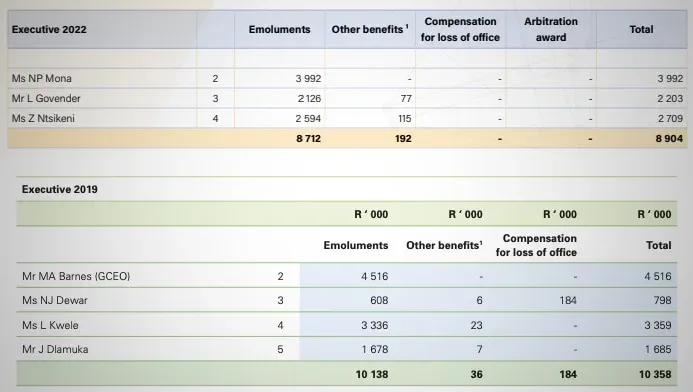
Mona was paid R3,992,000 in the fiscal year 2021/22, whereas Mark Barnes was paid R4,516,000 in the fiscal year 2018/19.
Barnes left on July 31, 2019, and was paid R2,882,000, according to SAPO’s 2020 annual report.
Because SAPO’s fiscal year begins in April, he earned four months’ compensation rather than five.
Even if the Post Office’s stated timescale of five months is used, Barnes’ annualised remuneration for the 2019/20 fiscal year is R6.9 million.
The Post Office also reacted to the DA’s allegations concerning outstanding debt and nonpayment of medical assistance and pension fund payments by employees.
“All current medical aid contributions are up to date, as at today,” SAPO argued.
“The only outstanding amount is what is historically owed to Medipos, over the years when no contributions were paid. SAPO is actively engaged in processes to deal with this historical aspect of Medipos debt.”
It also said the amount owed to Postbank is historic debt dating back to the time when the Postbank was a division of the SA Post Office.
“Notably, the separation of Postbank left the Post Office with an enormous loss of assets for which the Post Office was never compensated. We are engaging government in this regard.”