One of South Africa's most vital job sectors is experiencing a hiring boom
According to the Bureau for Food and Agricultural Policy, South African farms that feed the country and export commodities to other countries are employing more people, despite figures from Stats SA showing otherwise (BFAP). Statistics The Quarterly Labour Force Survey (QLFS) of South Africa (StatsSA) indicated that the agriculture industry saw major employment losses in
One of South Africa's most vital job sectors is experiencing a hiring boom
According to the Bureau for Food and Agricultural Policy, South African farms that feed the country and export commodities to other countries are employing more people, despite figures from Stats SA showing otherwise (BFAP).
Statistics The Quarterly Labour Force Survey (QLFS) of South Africa (StatsSA) indicated that the agriculture industry saw major employment losses in recent years; nevertheless, the current BFAP Agricultural Employment Brief for 2022 indicated job increase.
According to the BFAP, the QLFS lacks a defined methodology for survey weighting, and Stats SA’s reporting may have been influenced by changing survey results in light of the pandemic and a continuous lower-than-normal response rate.
“While there was a noticeable improvement in the past year with total survey responses of around 62,700 in the past quarter, this is still 7% lower than the average number of responses recorded in 2019,” said BFAP.
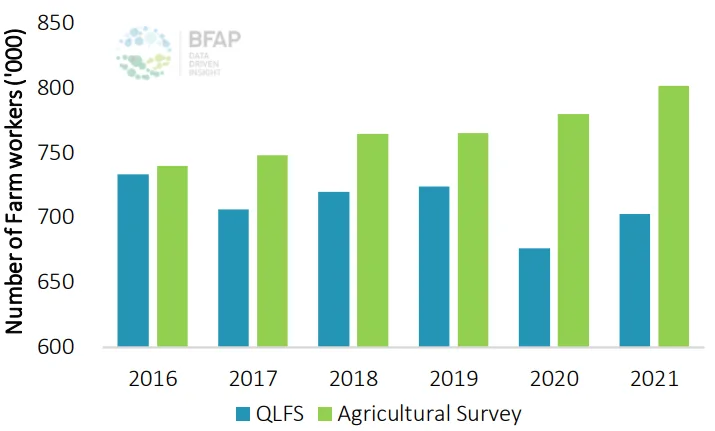
According to the organisation, the QLFS and Agricultural Survey had almost the same number of agricultural employees in 2016, at around 736,000.
“Since then, the jobs reported between these two sources started to diverge significantly, most notably in 2020, whereby the Annual Survey recorded an employment total that was 15% higher than that of the QLFS.”
“What is more striking about this deviation is that these two sources suggest a contrasting trend over time. The QLFS shows an agricultural labour market in flux, whereas the Agricultural Survey suggests job creation, especially between 2020 and 2021.”
Given the acknowledged problems connected with the QLFS, the BFAP thinks that the Agriculture Survey trend is a more true picture of the agricultural business and better shows the sector’s economic climate during the last few years.
The numbers below show an increase in the number of hired agricultural workers:
However, BFAP cautioned that an increased trend in employment is not assured to continue permanently.
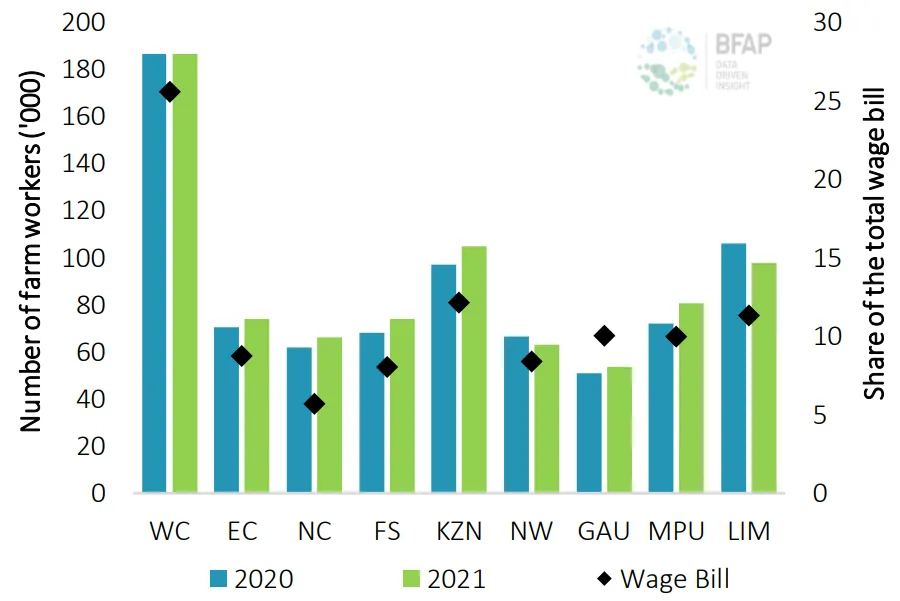
Farm worker employment is predominantly concentrated in the Western Cape between 2020 and 2021, with 186,600 farmworkers engaged. According to the BFAP, this is due to the unusually large concentration of labor-intensive businesses, namely irrigated fruit orchards and vineyards.
“Western Cape farmers, who produced around 20% of farm income in 2021, employed some 23% of the farm workers in the country in 2021.”
Limpopo, which used to employ the second most farmworkers, recorded a drop in employment, sliding to third place behind KwaZulu-Natal. According to BFAP, the only other province that witnessed employment losses except Limpopo was North West.
According to BFAP, the number of people working on farms increased in all other provinces.