Load-shedding deception by the energy minister
According to energy expert Chris Yelland, assertions that Eskom's energy availability factor might suddenly increase to end load shedding are deceiving the public. Gwede Mantashe, Minister of Mineral Resources and Energy, told eNCA that South Africa's energy issue might be resolved within six to twelve months. Mantashe commented on the load-shedding issue, saying: “it will
Load-shedding deception by the energy minister
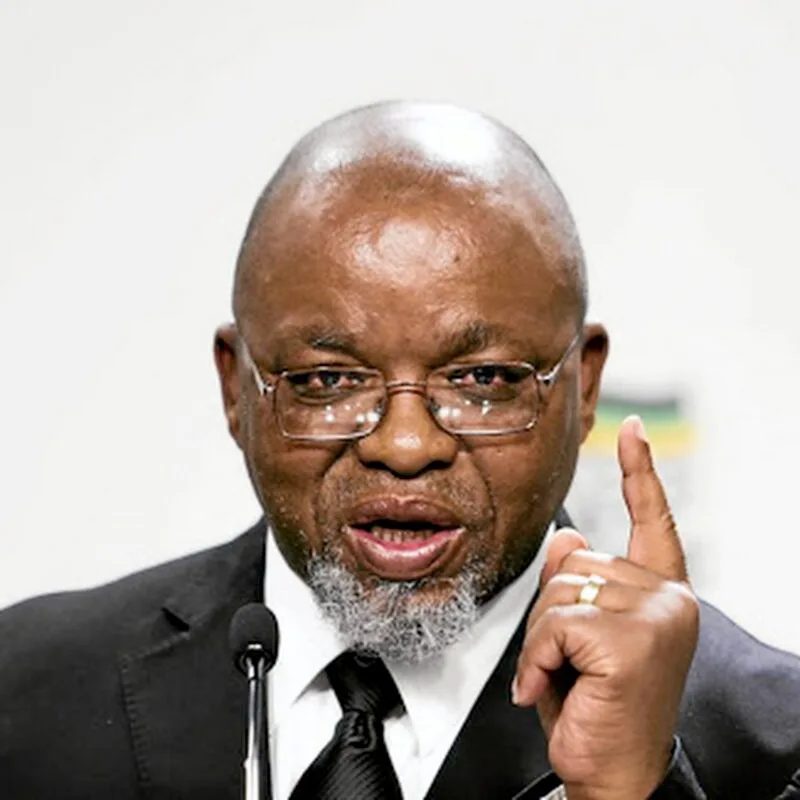
According to energy expert Chris Yelland, assertions that Eskom’s energy availability factor might suddenly increase to end load shedding are deceiving the public.
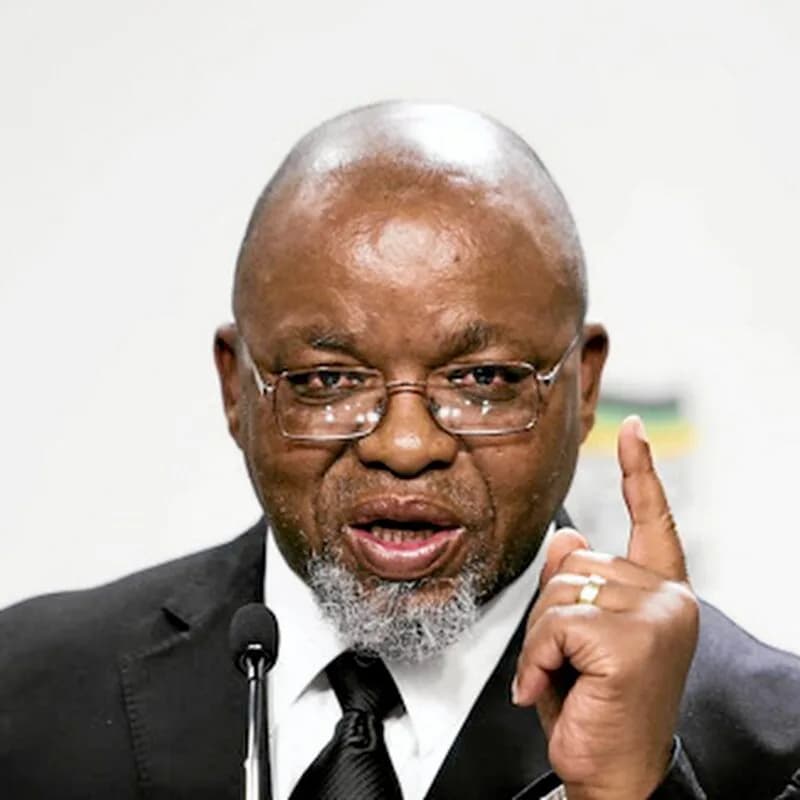
Gwede Mantashe, Minister of Mineral Resources and Energy, told eNCA that South Africa’s energy issue might be resolved within six to twelve months.
Mantashe commented on the load-shedding issue, saying: “it will take us six to 12 months to sort out the issue if we pay attention to it”.
“Eskom, as a state-owned entity, must do introspection to establish if it has the technical capacity to deal with the crisis. If not, can we go out and look for that capacity,” he said.
He went on to say that the Eskom power station managers are all young, trained engineers with little experience. “That is a shortcoming that we have to deal with and confront,” he said.
Mantashe stated that Eskom’s major issue is technical, and that discussion of green energy replacing coal-fired facilities is harmful.
“Talk of the closure of coal-fired power stations is creating an environment where people who run Eskom don’t see the urgency of ensuring that those power stations must give us energy,” he said.
Factor of energy availability at Eskom
Mantashe’s comments that South Africa’s energy situation may be handled in a year upon the nomination of a new Eskom board in October 2022.
The board’s mandate when it was appointed was to raise Eskom’s electricity availability factor (EAF) to 75%.
The energy availability factor indicates the percentage of time the power plant was operational when it was required. It is a key performance indicator.
Because Eskom’s EAF is directly related to load-shedding, there is a considerable emphasis on improving it.
Load-shedding will be eliminated if the EAF is increased to roughly 70%, and South Africa would enjoy power security.
Claims of resolving the energy crisis in six to twelve months and boosting the energy availability factor to 75%, on the other hand, are mistaken.
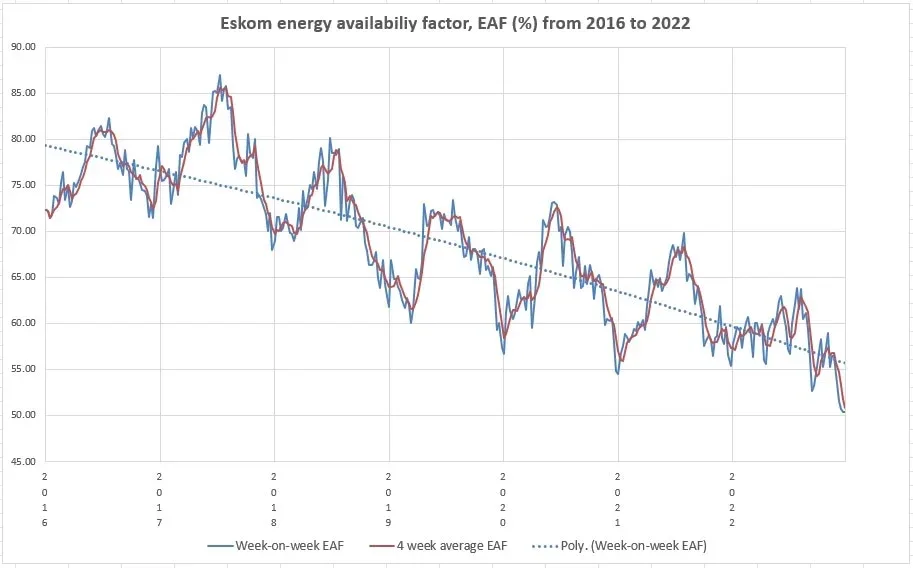
Chris Yelland, an energy specialist, highlighted that the energy availability factor has been falling over the past five years.
The EAF is based on the average performance of Eskom’s power producing fleet’s 90 generators. “You cannot maintain or fix them simultaneously,” he explained.
Mathematically, this indicates that the EAF is a continuum. The EAF trend cannot have a discontinuity, commonly known as a step shift.
“To increase Eskom’s EAF, there first has to be a slowdown. It then has to bottom out, stabilise, and start to rise. This process will take several years,” he said.
“It is mathematically impossible for this to happen in the 2023/2024 or 2024/2025 financial years,” Yelland said.
“Talk of a 70% or 75% energy availability factor is misleading the public, and it is not achievable by Eskom.”
Adding more capacity online
The option, as indicated by Mantashe, is to buy extra capacity to boost Eskom’s supplies.
However, the process of bringing new electrical generating online has failed horribly under his leadership.
The Risk Mitigation Independent Power Producer Procurement Programme (RMPIPP) has been marred by delays, mismanagement, allegations of corruption, and, finally, failure.
Another issue is that, even if solar and wind power facilities are swiftly built, the grid itself lacks the capacity to transport power from where it is generated to where it is required.
According to CSIR senior energy researcher Monique le Roux, strong wind and solar resources are situated in the Northern, Western, and Eastern Cape, where there is less demand.
“Those lines that carry the power from the South of the country where the good wind resource is have been completely utilised. They’re running at full capacity,” she said.
As a result, it is not practical to increase power producing capacity in the South to service people in South Africa’s north.
According to Intellidex capital markets chief Peter Attard Montalto, the Cape’s transmission systems would stay full until at least 2027.
According to Le Roux, the CSIR anticipates load shedding to continue for many years to come, based on scientific grounds.
“The notion that load-shedding will be gone in two years is definitely not watertight. It does not stand when you look at the energy availability factor of Eskom’s current power plants,” she said.
According to Le Roux, given the current facts, South Africa might face another decade of load-shedding.
Mantashe’s suggestion that South Africa’s electrical situation can be remedied in six to twelve months is thus deceptive.