
Here is the anticipated fuel price for February
Due to increased worldwide petroleum costs, mid-month data from the Central Energy Fund (CEF) predicts a lesser decline in petrol and diesel prices in February 2023. According to CEF statistics, as of 13 January 2023, petrol prices are predicted to fall by up to 25 cents per litre, while diesel prices are expected to fall

Here is the anticipated fuel price for February

Due to increased worldwide petroleum costs, mid-month data from the Central Energy Fund (CEF) predicts a lesser decline in petrol and diesel prices in February 2023.
According to CEF statistics, as of 13 January 2023, petrol prices are predicted to fall by up to 25 cents per litre, while diesel prices are expected to fall by 50 to 60 cents per litre.
The following are the anticipated changes:
- Petrol 93: decrease of 18 cents a litre;
- Petrol 95: decrease of 25 cents a litre;
- Diesel 0.05%: decrease 50 cents a litre;
- Diesel 0.005%: decrease of 63 cents a litre;
- Illuminating paraffin: decrease of 46 cents a litre.
The Department of Energy has underlined that the daily snapshots are not predictive and do not account for other potential changes such as schedule levy modifications or retail margin changes, which are calculated by the department at the end of the month after taking into consideration all aspects.
The Department of Education makes revisions after reviewing the full time. Furthermore, the picture may alter dramatically before the conclusion of the month. Finally, the anticipated price adjustments are dependent on present market circumstances continuing until the end of the month.
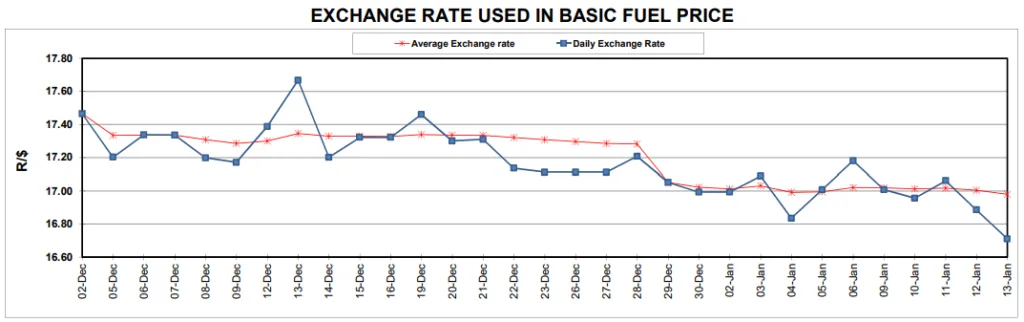
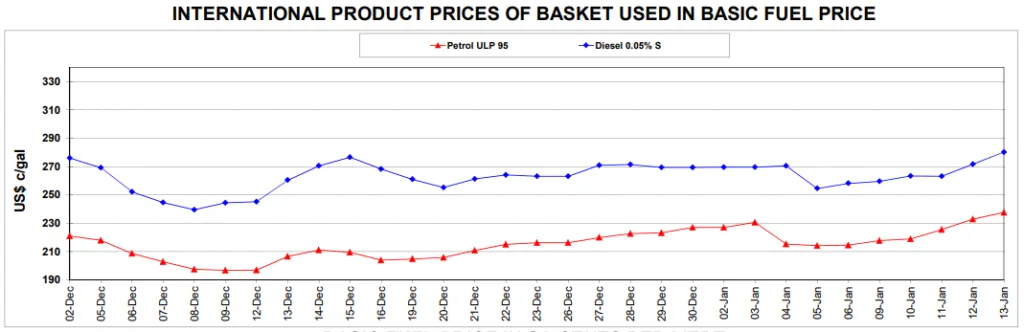
The changes in local fuel costs are influenced by two major factors: the worldwide price of petroleum goods, which is mostly determined by oil prices, and the rand/dollar exchange rate used to purchase these items.
Global oil prices fell considerably in the first half of the month before rebounding. While this movement continues to contribute to an over-recovery in local prices, its influence is less than it was at the beginning of the month. Meanwhile, the rand has stayed comparatively firmer against the dollar, adding to the projected decrease.

Rand
The rand began the week higher against the US dollar, trading back under the R17 level in early morning trade, at R16.74 to the dollar.
The rand’s fortunes are inextricably linked to global market circumstances, notably sentiment surrounding interest rate rises in the United States. The local currency is tossed around by expectations surrounding the US Federal Reserve’s interest rate changes, with markets continuously looking for clues as to what will happen next.
According to TreasuryOne, the dollar is trading lower across the board, which is helping emerging countries, including the rand. According to the report, the local currency might potentially challenge the R16.70 mark.
However, as US statistics released last week suggested that inflation is on a continuous lower trend, potentially allowing the US Federal Reserve to moderate the pace of policy tightening, this feeling may quickly reverse and put the dollar back on top.
When local variables such as chronic load shedding and much increased power prices are factored in, the rand is expected to follow a tumultuous course in the coming months.
For the time being, the rand’s position contributes to an over-recovery of 14 to 17 cents per litre for gasoline and diesel, respectively.
Oil
After favouring a story of abundant supply and little demand, which drove down prices, oil markets have recovered as China’s opening up following a disastrous zero-covid policy has resulted in yet another shift in opinion.
The price decline was mostly influenced by market sentiment over demand, with experts forecasting weak demand from labor-intensive economies such as China – while supply fears alleviated.
However, with the world’s second-largest economy abruptly declaring that it is open for business, the picture for demand has shifted.
According to Bloomberg, China’s reopening might result in a boom in global economic activity, but this could be accompanied by an increase in oil prices. Indeed, oil is presently trading closer to $85 a barrel than it was a week ago.
After years of stringent lockdowns, China abandoned Covid-19 limits in late 2022. This is expected to boost economic activity and mobility, with economists predicting that oil demand in the world’s biggest crude importer would likely reach a new high.
“Crude has had a bumpy start to the year, collapsing in the opening week before rebounding. In addition to China’s swift pivot, support for crude prices in recent sessions has come from growing expectations that the Federal Reserve is now nearing an end to rate hikes, and a weakening dollar. Traders are also tracking the impact of sanctions on Russian oil and product flows,” Bloomberg said.
Traders remain wary, though, and will continue to assess how soon China will be able to recover, as well as what this means for the market in the future.
International petroleum product costs are currently rising, contributing to a minor over-recovery in local prices of 3 to 45 cents per litre.
This is how the anticipated price adjustments may appear at the pump:
| Inland | January Official | February Expected |
| 93 Petrol | R21.10 | R20.92 |
| 95 Petrol | R21.40 | R21.15 |
| 0.05% diesel (wholesale) | R21.23 | R20.73 |
| 0.005% diesel (wholesale) | R21.42 | R20.79 |
| Illuminating Paraffin | R15.26 | R14.80 |
| Coastal | January Official | February Expected |
| 93 Petrol | R20.45 | R20.27 |
| 95 Petrol | R20.75 | R20.50 |
| 0.05% diesel (wholesale) | R20.58 | R20.08 |
| 0.005% diesel (wholesale) | R20.78 | R20.15 |
| Illuminating Paraffin | R14.47 | R14.01 |