Even Elon Musk will not be able to revive Eskom, but private power will save South Africa
Even Tesla CEO Elon Musk couldn't save South Africa's struggling power grid and end load shedding. According to Michael Jordaan, former FNB CEO and founder of venture capital firm Montegray Capital. Jordaan was recently interviewed for PSG's Think Big series, where he was asked for his thoughts on how to solve Eskom's challenges. Jordaan stated
Even Elon Musk will not be able to revive Eskom, but private power will save South Africa
Even Tesla CEO Elon Musk couldn’t save South Africa’s struggling power grid and end load shedding.
According to Michael Jordaan, former FNB CEO and founder of venture capital firm Montegray Capital.
Jordaan was recently interviewed for PSG’s Think Big series, where he was asked for his thoughts on how to solve Eskom’s challenges.
Jordaan stated that he believed the government lacked a sufficient sense of crisis and that he would never run for the position of Eskom CEO.
“You have to be crazy to do that job,” Jordaan said, explaining that the only way someone could be successful in the role is if they were able to choose the best team and had the support of their shareholders.
“You can put Elon Musk in there, and you won’t succeed,” he stated.
Following his interview, Jordaan appeared to humorously challenge Musk to “prove him wrong” on Twitter.
Many South Africans have urged the billionaire industrialist to utilise his energy firm, Tesla, to help the country overcome its power crisis on Twitter.
While the proposals appear to be mostly in fun, they are frequently infused with genuine optimism.
Tesla has had significant success in developing power systems for different purposes using their electric car battery storage technology.
This includes energy storage systems such as the Tesla Powerwall for households and businesses and the Megapack for utility-scale energy storage, all of which are available in South Africa.
It also sells solar panels and roofing.
When it comes to making the most of South Africa’s renewable energy capability, the usage of battery storage might be advantageous.
Plenty of solar and wind power generated by private generators throughout the day is squandered since it is generated when demand is low.
According to Eskom’s statistics portal, the maximum renewable output of wind and solar in South Africa will reach 5,000MW in 2022.
However, the utility’s nighttime peak demand records indicate renewables contributing less than 2,000MW under favourable conditions.
The ability to dispatch some of the extra power generated during the day during peak demand hours may help to reduce the requirement for load-shedding.
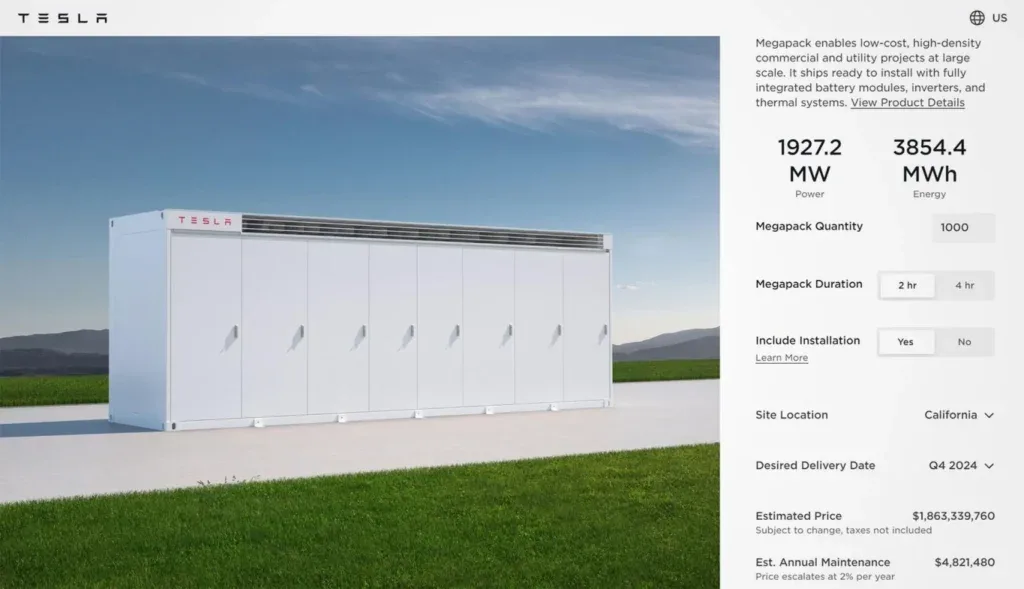
Each of Tesla’s Megapack batteries, for example, can store 3.9MWh of capacity and about half the output while costing around $2.5 million (R43.22 million) when supplied to California, including installation.
As the number of orders grows, the price per battery decreases.
The Tesla website only accepts orders for a maximum of 1,000 units. This quantity of Megapacks may store more than 3,854MWh of energy.
Their built-in inverters can produce around half that much – a peak of 1,927MW — which is almost the same as Koeberg at full capacity.
When completely charged, this combination could avoid around two phases of load-shedding for two hours.
A smaller inverter system also allows for a one-stage reduction in load-shedding across four hours.
The prices range between $1.7 billion (R29 billion) to $1.86 billion (R32 billion), not including transportation.
For comparison, Eskom’s newest coal power plants, Medupi and Kusile, have a combined nameplate capacity of 9,600MW, or about five times the capacity of 1,000 Megapacks.
However, technical issues and corruption have resulted in cost overruns that have pushed their prices far over R300 billion, and capacity is likewise much below the maximum envisioned.
Despite only being able to produce a fifth of these plants’ maximum theoretical capacity for a short number of hours, the 10,000 Megapacks would cost around a tenth on a per-MW basis.
Eskom has begun building its own battery energy storage system (BESS), which will have a capacity of 1,440MWh and a peak output of 343MW when completed in December 2024 – if Eskom meets the deadline.
In 2023, home solar power will already assist minimise load shedding
Concerning more immediate remedies, Jordaan stated that the load-shedding situation provided a significant challenge as well as an opportunity for entrepreneurs.
Solar power, according to Jordaan, could be quickly adopted with sustainability in mind because it is already cheaper than Eskom energy during the day.
“The primary motivation is not even ‘green’ but cost efficiency and business continuity,” Jordaan explained.
Jordaan also stated that solar power in the private sector, but outside of Eskom’s IPP scheme, is already comparable to one stage of load-shedding in 2022.
He went on to say that he was certain that this capacity will avoid South Africa from “multiple” episodes of load-shedding in 2023.
According to Jordaan, companies should not hold out hope that the government would solve the energy situation.
“It is critical for businesses to avoid political finger-pointing and rather focus on seeking private-sector solutions wherever possible.”
He stated that the option was especially appealing for large consumers who could resell power.
This is because banks and other financiers are willing to offer upfront project capital at interest rates that allow the investment to be recouped by charging cheaper energy costs than Eskom.
As a result, Jordaan predicted that enough demand would migrate off the grid to increase supply to those who couldn’t afford solar.
He expects that in six months, the electricity scenario will be better without the need for government involvement.