Afriforum is launching its own power firm, with nuclear aspirations in the works
Afriforum, a civil rights organisation, is developing its own power generation firm, with ambitions to build South Africa's first Pebble Bed Modular Reactor (PBMR). Kallie Kriel, the organization's CEO, recently discussed these goals with Sunday newspaper Rapport and online Afrikaans outlet Maroela Media. Kriel stated that Afriforum was already in contact with numerous energy sector
Afriforum is launching its own power firm, with nuclear aspirations in the works
Afriforum, a civil rights organisation, is developing its own power generation firm, with ambitions to build South Africa’s first Pebble Bed Modular Reactor (PBMR).
Kallie Kriel, the organization’s CEO, recently discussed these goals with Sunday newspaper Rapport and online Afrikaans outlet Maroela Media.
Kriel stated that Afriforum was already in contact with numerous energy sector participants to expand the role of private power in South Africa.
André Pienaar, a South African-born venture financier and stakeholder in PBMR business X-Energy, is among them.
In the state of Washington, X-Energy is currently constructing the world’s first commercial-scale advanced nuclear reactor.
It is part of the $2.5 billion (R43 billion) Advanced Reactor Demonstration Program of the US Department of Energy (ARDP).
The ARDP will witness the development of X-first Energy’s 320MW XE-100 power plant, which will comprise of four 80MW PBMRs.
The helium-cooled, high-temperature reactors are intended for small-scale power generation with shorter deployment periods and more safety than big conventional reactors.
The PBMR is made out of a steel pressure vessel with a graphite core filled with enriched uranium dioxide fuel “pebbles” the size of a pool (billiards) ball.
A Tristructural Isotropic (Triso) covering forms an airtight barrier around the uranium kernel, allowing the plant to be erected within 500 metres of industry or metropolitan areas.
“The fresh pebbles are loaded in the reactor like a gumball machine, and helium is pumped down through the pebble bed to extract the heat into a steam generator that produces electricity,” the US Department of Energy explains.
“The reactor continuously refuels by adding fresh pebbles daily in at the top, as older ones are discharged from the bottom of the core.”
“Each pebble remains in the core for a little more than three years and are circulated through the core up to six times to achieve full burnup.”
The stones are continually spun by gravity to generate heat. The heat transforms water into steam, which drives a turbine.
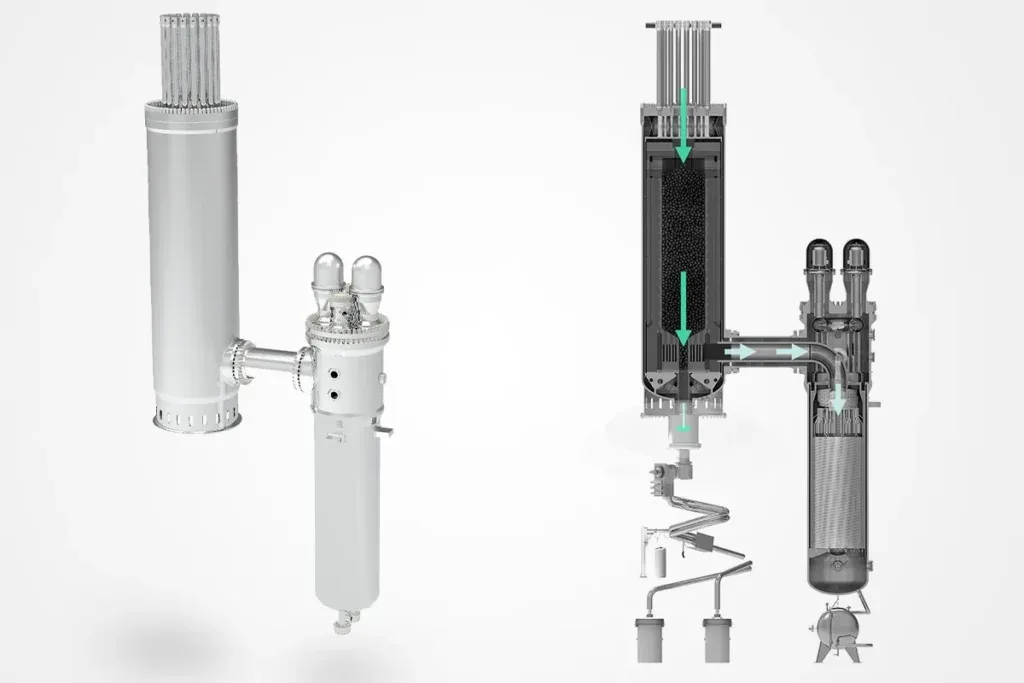
X-Energy has also agreed to supply the US military with Xe-mobile mini reactors for distant operations.
Surprisingly, the first iterations of PBMR were created by a South African team as part of Eskom’s PBMR business.
The utility intended to employ the technology to build a new nuclear power station in Duynefontein, near Koeberg.
However, after 10 years of research and rising expenditures, the project was cancelled owing to a lack of funding.
Eben Mulder, one of these team members, was acquired by X-Energy and currently serves as the company’s chief scientist.
Martin van Staden, a North-West University and University of Johannesburg alumni, is the reactor’s principal developer.

Although renewable energy sources such as wind and solar are significant resources for South Africa’s future, their outputs are very intermittent, according to Kriel.
South Africa, as many South African energy experts have pointed out, requires more stable baseload capacity that varies less and can be deployed on demand during peak usage periods.
However, because to their high levels of carbon emissions, the two primary kinds of power generation that normally allow for this — coal and gas — are becoming increasingly unpopular.
Afriforum’s major responsibility in the case of PBMR will be to attract the requisite investors and skills for local development.
According to Afriforum, nuclear power generation emits no greenhouse gases, and radioactive waste disposal processes have improved greatly to assure minimal environmental effect – both in terms of area occupied and safety.
The stones in X-Triso-X Energy’s fuel are deposited straight into dry casks and stored on-site, without the need for intermediate or active cooling.
Other areas of attention are included in the plan.
Although Afriforum estimated that developing and building a PMBR plant in South Africa would take a decade, the organisation was also working on quick and medium-term options to assist resolve the power problem.
The organisation intends to push the National Energy Regulator of South Africa (Nersa) to modify some power generating restrictions in the first phase of its initiative, termed Projek AfriEnergie.
In addition, during the first phase, a consumer guide containing guidance and supplier data for installing embedded home generating such as solar power will be introduced.
The second phase will concentrate on assisting cities and towns in reducing their dependency on Eskom for power supplies.
Kriel stated that the Mafube municipality in the Free State had been supplying privately generated power to the town of Frankfort for 10 years.
Kriel agreed that there was no fast resolution for the country’s energy issue, but he believes civic society and the business sector can play an important part in a future “on the other side” of Eskom.