




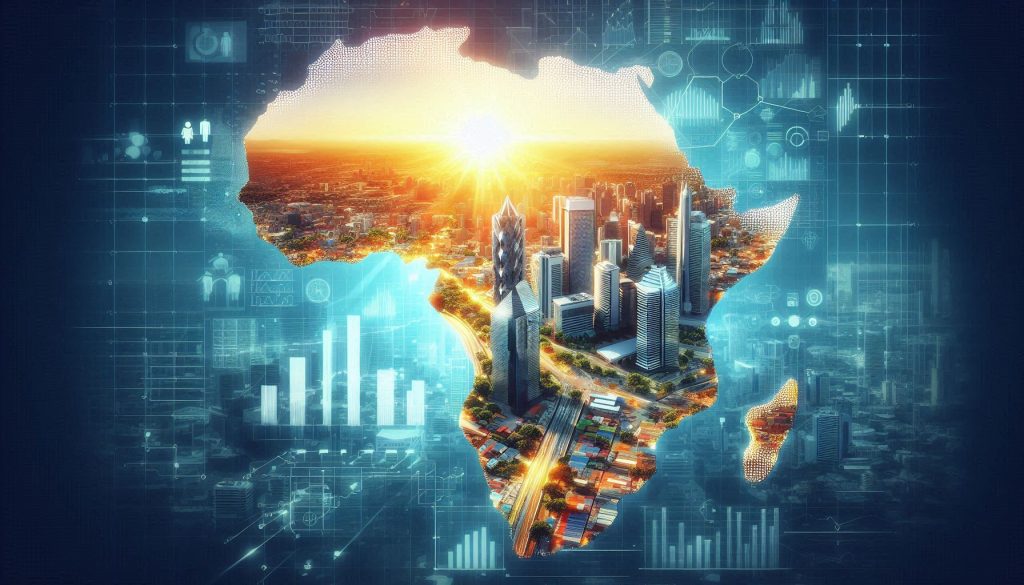
As an African, I admit my frustration grew when I read Teneo’s “Vision 2026: Where is the World Going in 2026 and Beyond?” report.
Released in December 2025, this survey of over 350 global CEOs and 400 investors (representing $19 trillion in assets) paints a picture of cautious optimism: steady growth, AI-driven transformation, rising M&A, U.S. leadership, India’s emergence, and accelerating de-globalisation.
Yet, in its 21 pages, Africa, the continent with the world’s youngest population with a median age of 19.7, and projected to house 25% of humanity by 2050, and home to some of the fastest-growing global economies, does not appear once. Not in investment priorities, not in geopolitical shifts, not even as a footnote. This isn’t oversight; it’s a pattern in the global consulting industry that renders an entire continent invisible in discussions about the “global” future.
This erasure is particularly galling in a report emphasising “recalibrated globalisation” and APAC’s rise. Africa is undergoing its own recalibration via the African Continental Free Trade Area (AfCFTA), potentially adding $450 billion to continental GDP by 2035 (World Bank estimates). Its tech ecosystem raised $6.5 billion in 2024 alone, and nations like Nigeria, Kenya, and Egypt are AI adoption leaders in emerging markets. Excluding Africa distorts the global outlook: It ignores a demand engine with 1.4 billion consumers, vast critical minerals for the green transition, and a workforce that could redefine AI’s “workforce dividend” the report celebrates.
Sadly, Teneo is not alone. Many “global” reports from elite consulting firms suffer from sampling bias, Western-centric networks, and a risk-averse focus on established markets. Africa often gets relegated to separate, smaller reports, if covered at all. This perpetuates a cycle: Limited data leads to limited attention, which justifies further exclusion.
Notable “Global” Reports Excluding or Marginally Covering Africa
| Report Title & Firm | Date | Key Claims on Future Pathway | Africa Coverage | Source/Link |
|---|---|---|---|---|
| Vision 2026: CEO and Investor Outlook (Teneo) | Dec 2025 | Steady growth; AI ROI chase; U.S. leads, India rises; deglobalization accelerates; hiring up via AI. | None—no mention despite “global” survey of 750+ leaders. | teneo.com/vision2026 |
| 28th Annual Global CEO Survey (PwC) | Jan 2025 | 60% CEOs optimistic on growth; reinvention via AI/tech; climate pressures; headcount increases. | Minimal in main report; separate Sub-Saharan Africa edition with 200 CEOs. | pwc.com/gx/en/ceo-survey/2025 |
| Global CEO Outlook 2025 (KPMG) | Oct 2025 | CEOs adapt to interconnected challenges; growth strategies shift; confidence in economy low globally. | None in main global; dedicated Africa CEO Outlook (130 leaders) released separately. | kpmg.com/global-ceo-outlook |
| CEO Outlook Survey September 2025 (EY) | Sep 2025 | Confidence amid disruption; resilience/growth strategies; tech/AI risks top concerns. | Limited emerging markets depth; no dedicated Africa section in global edition. | ey.com/en_gl/ceo/ceo-outlook-global-report |
| Global Economics Intelligence (McKinsey) | Monthly (e.g., Oct 2025) | Slow growth baseline; policy volatility; focus on advanced economies and China/India. | Occasional mentions (e.g., commodities), but no substantive Africa integration in global forecasts. | mckinsey.com/capabilities/strategy-and-corporate-finance/our-insights/global-economics-intelligence |
These reports claim authoritative global insights yet draw heavily from North America, Europe, and Asia-Pacific executives. Africa’s representation is often less than 5% (when disclosed at all), leading to its erasure from narratives on AI scaling, de-globalisation, or investment flows.
A Reasoned Critique: Outrageous and Shortsighted
This exclusion is outrageous because it is intellectually dishonest. Claiming a “global” view while omitting a continent of 54 nations and 18% of the world’s population undermines credibility. Africa’s youth bulge holding over 60% of global under 25’s, positions it as the ultimate talent powerhouse for AI enablement, yet reports fixate on aging demographics elsewhere. Its growth averages 4-5% projected for 2026 (IMF), outpacing global 3.2%, driven by intra-African trade and digital leaps.
The reasons for Africa’s omission are structural: Consulting firms’ client bases and networks skew toward Fortune 500 companies in mature markets. Surveying African CEOs is logistically harder and perceived as riskier. But this creates self-fulfilling prophecy – Africa gets deprioritised in boardrooms because it’s absent from these influential reports.
More insidiously, it echoes colonial-era mapping that blanked out Africa’s interior as “unknown.”
In 2026, ignoring Africa risks missing the next India-like emergence. The continent’s fintech biotech and renewable energy potential, in addition to it’s critical mineral dominance (60% of global cobalt) are pivotal for the AI and green transitions that these reports champion.
Firms should be prioritising sampling growth to include an African view and look to partner with African institutions like the African Development Bank or Tony Elumelu Foundation, and integrate findings into main reports. Investors and CEOs should demand better: Africa’s exclusion leads to incomplete strategies in a truly multipolar world.
Ironically these are the companies that also rigorously promote ideals such as “inclusion” “democratisation of everything” (whatever that means) and that diversity is good for growth.
Thankfully, Africa isn’t waiting for validation from these reports or companies. Its Business leaders are building resilient, AI-ready groups and catalysing economic growth and beginning to prioritise infrastructure developments such as energy, despite the blind spots. Reports like Teneo’s may shape Western perceptions, but they don’t define our trajectory as Africans.
The real global outlook for 2026? One where Africa’s voice, and value, can no longer be ignored by global players.